By Nitin Kanish · 11 October 2026
Most visitors to Bhubaneswar know the temples of the old town, and many drive on to Puri, Konark or Chilika. Far fewer head north-east, into the farmland of Cuttack and Jajpur districts, where three low hills hold the ruins of some of the most important Buddhist monasteries in eastern India. Together, Lalitgiri, Udayagiri and Ratnagiri are known as the "Diamond Triangle". They are close to each other but far from bus routes, which makes them a perfect day out with a car rental in Bhubaneswar.
This guide walks you through the route, the best order for the three stops, what to look for at each site and how to keep the day relaxed. If you own a car in Bhubaneswar, it also shows the kind of long, planned day trip that visitors book a reliable, well-reviewed car for.
Key Takeaways
- Distance: by OSRM routing, about 87 km from central Bhubaneswar to Lalitgiri, about 10 km on to Udayagiri, about 11 km to Ratnagiri, and about 92 km back. That is a full loop of roughly 200 km.
- Lalitgiri: the oldest of the three, where excavations found stone caskets holding relics believed to be of the Buddha inside a hilltop stupa.
- Udayagiri: the largest Buddhist complex in Odisha, with a brick stupa, monasteries and an inscribed stepped well.
- Ratnagiri: the "hill of jewels", with a great monastery whose carved stone doorway is among the finest surviving in India, plus a site museum.
- Best plan: leave by 7 am, go to the farthest sites in the cool morning and keep the afternoon for the museum and the drive home.
- Book: compare cars and host reviews on the Bhubaneswar car rental page.
Why the Diamond Triangle is worth a full day
Odisha's Buddhist past is not as well known as its temple architecture, but it is deep. According to the Archaeological Survey of India's excavations, summarised on Wikipedia's Lalitagiri page, Buddhism had an unbroken presence at Lalitgiri for well over a thousand years. Ratnagiri grew into a major monastery from around the 5th century CE, with its busiest building period between the 7th and 10th centuries. Udayagiri, known in old inscriptions as Madhavapura Mahavihara, was active from about the 7th to the 12th century.
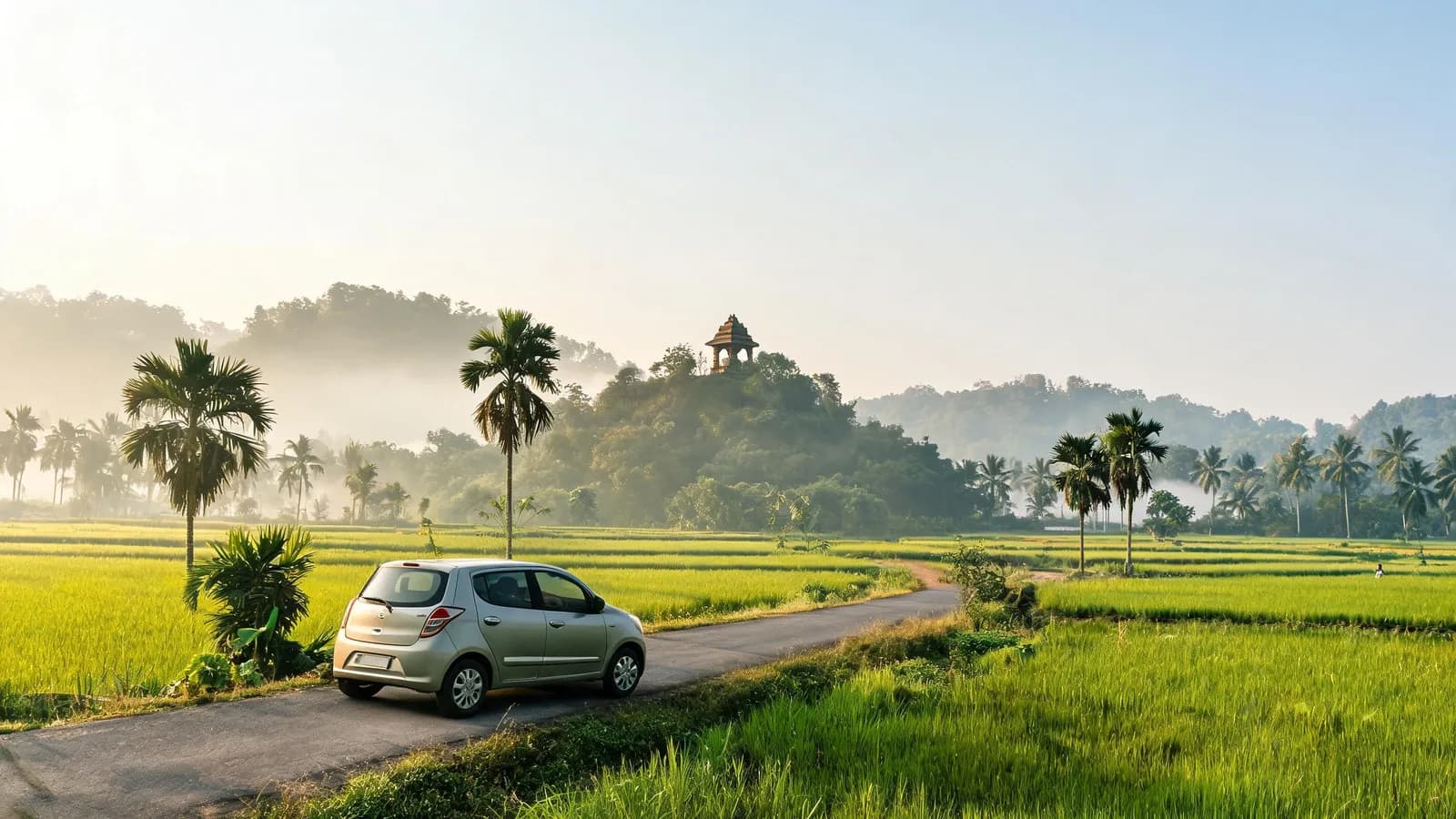
What makes the trip special is the setting. These are not crowded city monuments. You walk on quiet hilltops among brick stupas, stone sculptures and the outlines of monks' cells, with paddy fields, palms and village ponds all around. On a weekday you may have long stretches of a site almost to yourself.
The sites also sit far enough from each other and from the main highway that public transport is slow and patchy. With your own car, you set the pace, linger where you like and still get home for dinner.
The route from Bhubaneswar
From Bhubaneswar, head north towards Cuttack and then continue north-east on the highway towards Chandikhol, before turning off onto smaller district roads towards the hills. Your navigation app will choose the exact turns, and it is worth following it closely, because the last stretch passes through villages and junctions without big signboards.
By OSRM routing, the legs look like this:
- Bhubaneswar to Lalitgiri: about 87 km, roughly 1 hour 10 minutes without traffic.
- Lalitgiri to Udayagiri: about 10 km, around 15 to 20 minutes.
- Udayagiri to Ratnagiri: about 11 km, around 15 to 20 minutes.
- Ratnagiri back to Bhubaneswar: about 92 km, roughly 1 hour 15 minutes without traffic.
Real driving times are usually longer. Traffic through Cuttack, slow trucks on the highway and village markets can all add time. Plan for about two hours each way to be comfortable.
Road tips
- Leave early. Starting by 7 am gets you past the Cuttack traffic and onto the hills before the midday heat.
- Fuel up in the city or on the highway. Fuel stations are fewer once you turn onto the rural roads.
- Watch for cattle, cycles and tractors. The village roads are narrow and shared by everyone.
- Carry water and snacks. There are small tea stalls near the sites, but choices are limited.
- Avoid driving back late. Rural roads are poorly lit, so aim to reach the highway before dark.
Stop 1: Lalitgiri, the oldest of the three
Lalitgiri sits between two sandstone hills in Cuttack district. It is the oldest Buddhist site in the area, and archaeologists believe it was in use from the post-Mauryan period right through to the 13th century.
Its most famous discovery came during the Archaeological Survey of India's excavations between 1985 and 1991. Inside the large stupa on the hill, they found two stone caskets. Each held smaller boxes nested inside one another, of steatite, silver and gold, and the gold one contained a tiny piece of bone believed to be a relic of the Buddha. It was the first such find in eastern India.
What to see:
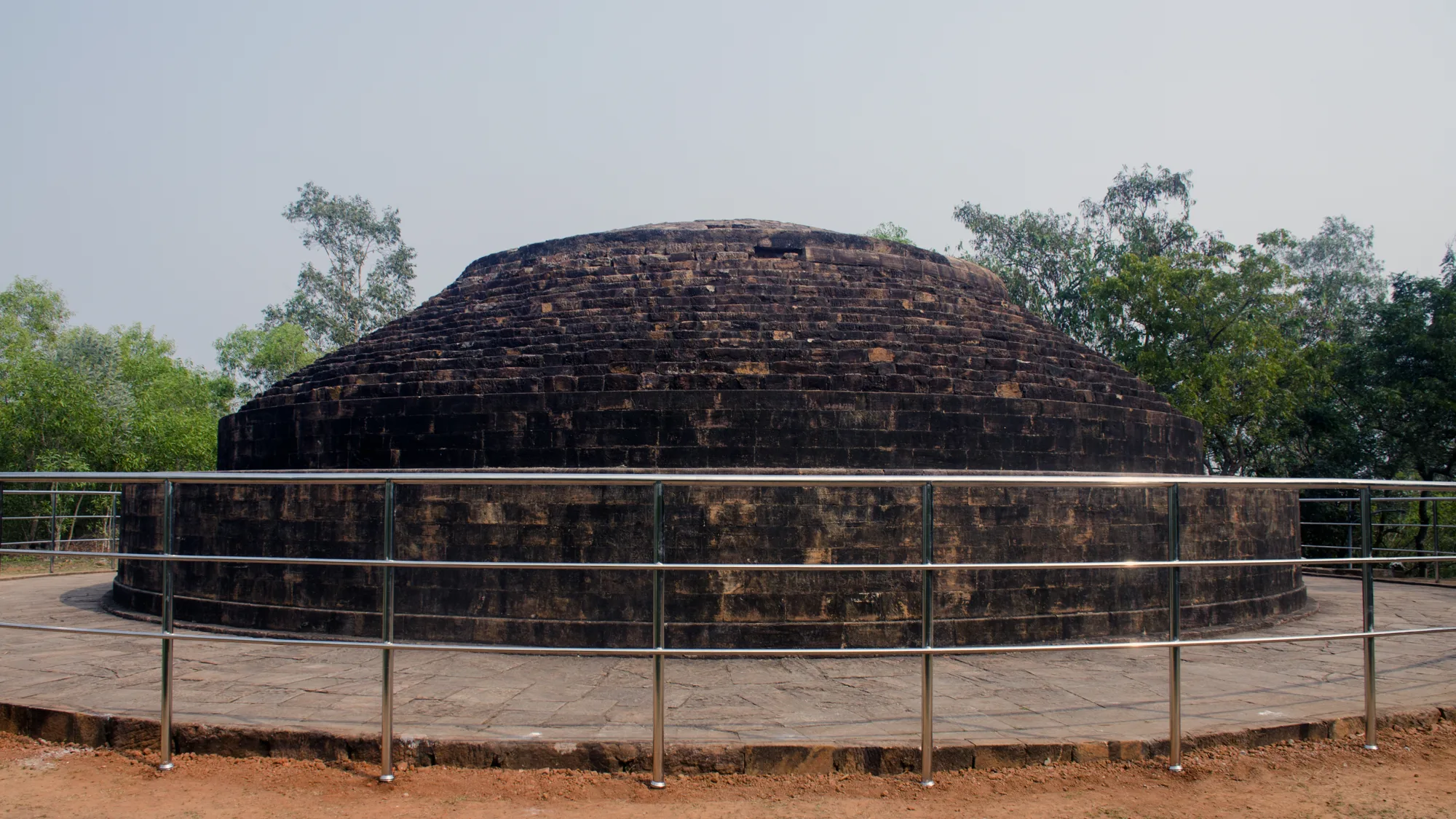
- The main stupa on the hilltop, a broad brick dome where the relics were found.
- The apsidal chaityagriha, a long brick prayer hall with a rounded end, the first structure of its kind found in Odisha.
- Monastery remains, where you can trace the rooms and courtyards in the brickwork.
- The site museum, which displays sculptures recovered from the site.
Stop 2: Udayagiri, the largest complex
A short drive from Lalitgiri brings you to Udayagiri, in Jajpur district. It is the largest Buddhist complex in Odisha, set in the foothills with two main excavated areas.
Inscriptions found here identify it as Madhavapura Mahavihara. The site includes a brick stupa with four seated Buddha images facing the four directions, monastic buildings, and a stepped stone well with inscriptions. Look out, too, for the small carved figure near one of the gates of a person swinging on a rope with eyes closed, a little moment of joy in stone.
Udayagiri is more spread out than the other two, so wear comfortable shoes and give yourself about an hour. Some parts of the site are in open ground with little shade, which is another reason to arrive in the morning.
Stop 3: Ratnagiri, the hill of jewels
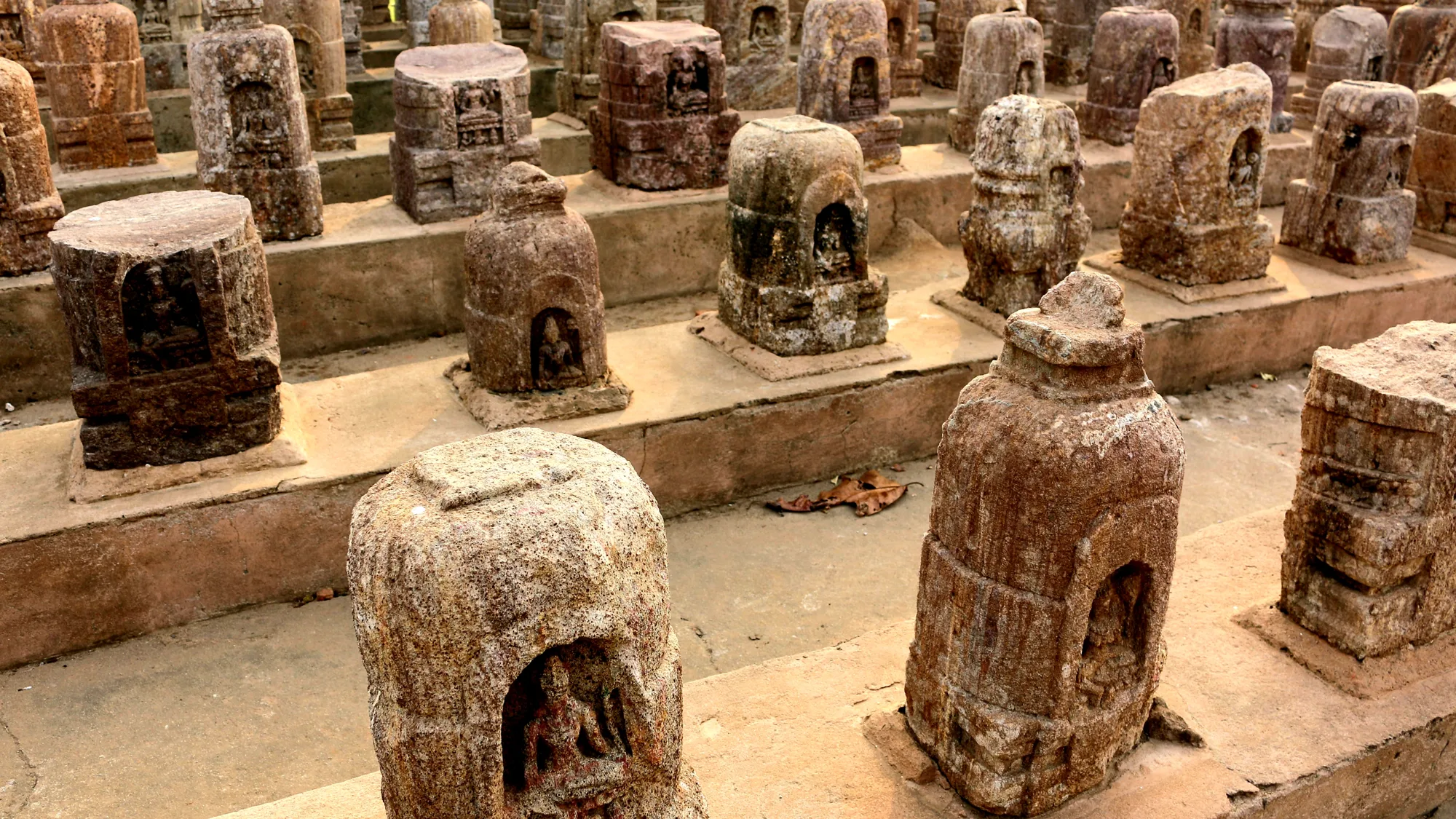
Ratnagiri means "hill of jewels", and for many visitors it is the highlight. The ruined mahavihara stands on a hill between the Brahmani and Birupa rivers. It was little known until excavations by the Archaeological Survey of India in the 1960s revealed a huge stupa, hundreds of smaller votive stupas and three monasteries.
Monastery 1 is the star. Scholars have described its carved stone decoration as among the finest to survive in India. Walk through the doorway, carved in blue-green chlorite and the local plum-toned khondalite stone, into the paved courtyard. Across it sits the main shrine with a colossal seated Buddha, about 12 feet high including the base, flanked by standing figures of Padmapani and Vajrapani. The monastery once had at least two storeys; today only the ground floor and its cells remain.
Many of the finest sculptures found here, including large Buddha heads, are shown in the site museum. Read more on the Wikipedia page on Ratnagiri before you go, so you know what to look for.
Which order should you visit in?
Lalitgiri, then Udayagiri, then Ratnagiri works well for most people. You start with the oldest site, build up to the largest, and finish at the most decorated, with the museum to round off the day. It also means the longest drive home starts from Ratnagiri, after the hottest part of the day has passed.
If you are short on time, choose Ratnagiri and Lalitgiri, and come back another day for Udayagiri. Trying to rush all three in a half day is not much fun.
A simple plan for the day
- 7:00 am: leave Bhubaneswar and cross Cuttack before the traffic builds.
- 9:00 am: Lalitgiri, the main stupa, chaityagriha and museum.
- 10:45 am: drive to Udayagiri and explore the excavated areas.
- 12:30 pm: lunch break with simple local food or your packed meal.
- 1:30 pm: Ratnagiri, Monastery 1 and the site museum.
- 3:30 pm: start the drive back, aiming to reach the city around sunset.
These times are only a guide. Site and museum opening hours and entry rules are set by the Archaeological Survey of India and can change, and site museums often have a weekly closing day, so check the latest details before you go.
When to go
October to February is the most comfortable time. The monsoon has eased, the fields are green, and the mornings are cooler, which matters because you will spend a lot of time walking in the open. From March the heat builds quickly, and in the monsoon the rural roads can be muddy and slow.
Weekdays are quieter than weekends. If you like photography, the soft morning light at Lalitgiri and the late-afternoon light on Ratnagiri's stone carvings are both lovely.
Respecting the sites
- These are protected monuments. Do not climb on stupas, walls or sculptures.
- Follow the signs about photography, especially inside the museums.
- Dress modestly and remove shoes where asked at shrines.
- Take your rubbish back with you; bins can be few.
Combine it with other Odisha drives
If you have more days in Bhubaneswar, pair this heritage day with a coastal one. Our guide to driving from Bhubaneswar to Chilika's dolphins covers a very different side of Odisha, with lagoon boats and wide water. And if Buddhist history is your interest, you may also like our self-drive guides to Sarnath from Varanasi and Nagpur's Buddhist trail.
Choosing the right car
The roads are mostly good, so you do not need a big SUV. A comfortable hatchback or sedan with good air conditioning is enough for two to four people. For a family with older relatives, a car with more legroom makes the 200 km loop easier.
On Hire N Ride, each car is listed by a local host with a profile, photos and reviews from earlier renters. Read those reviews before you book. A host with many good reviews on long trips is a good sign for a day like this. You can compare options on the Bhubaneswar car rental page. Hire N Ride is often compared with other self-drive platforms such as Zoomcar; the difference is that you are booking from a real host who has built a reputation.
For car owners in Bhubaneswar
Day trips like the Diamond Triangle are exactly what many visitors want a clean, reliable car for. If you own a car in Bhubaneswar, you can list it on Hire N Ride like a home on Airbnb. You build a professional host profile, and every good trip adds to your reviews and reputation, which in turn brings more bookings.
Hire N Ride also helps manage the business side, so you can focus on keeping your car ready. That includes vehicle surveys, GPS management, and reminders for insurance renewal, PUC certificates, RC, permit expiry and servicing. Start on the List Your Vehicle page.
Ready to plan your trip?
Riders: book a self-drive car from a trusted local host on the Bhubaneswar car rental page.
Car owners: turn your car into a business and become a host on Hire N Ride.
Conclusion
The Diamond Triangle shows a side of Odisha that many travellers miss: quiet hilltops where monks lived, studied and carved stone for centuries. In one well-planned day, you can see relic stupas at Lalitgiri, the wide monastery grounds of Udayagiri and the remarkable doorways of Ratnagiri, then be back in Bhubaneswar by evening. Leave early, carry water, check site timings and let the car do the hard work. You can also read the overview of Udayagiri to prepare.