By Manjot Kaur · 21 October 2026
Most visitors buy Jaipur's block-printed cotton in the old city bazaars. Fewer go and see where it is made. Two towns on the city's southern edge, Sanganer and Bagru, still print cloth by hand with carved wooden blocks, and both have their craft registered as a Geographical Indication (GI) with the Government of India. They sit far enough apart to need your own wheels and close enough to cover in one easy day, which makes this a natural ride for anyone using a bike rental in Jaipur.
October is a good month for it. The heavy rain that pauses outdoor dyeing is over, the drying yards are busy again, and the morning air is cool enough for open-road riding. This guide covers the route, what to see in each town, how to book a hands-on printing session, and how to tell real hand block prints from cheap copies.
Key Takeaways
- The loop from Jaipur Junction to Sanganer, on to Bagru and back is about 80 km by map routing, well inside the 120 km a day included with the lowest-priced scooter on the Hire N Ride Jaipur page on 21 October 2026.
- Sanganeri Hand Block Printing and Bagru Hand Block Print are separate registered GIs: Sanganer's certificate is dated 19 March 2010 and Bagru's 11 May 2011.
- Sanganer is known for bright patterns on white grounds; Bagru for earthier colours and dabu, a mud-resist paste used with indigo.
- In Sanganer, add the red-stone Sanghiji Jain temple and the Kagzi handmade paper units, which sit close together.
- Mornings are when the printers are most active. Book workshops in advance, and note that one Bagru workshop lists itself as closed on full-moon days; the next full moon falls on 26 October 2026.
Why ride to Sanganer and Bagru by bike
Neither town is a sight in the usual sense. The interesting parts are in lanes, courtyards and open plots where cloth is printed, dyed, washed and laid out to dry. A scooter or motorcycle lets you stop wherever you see fabric drying, park in narrow streets, and move between workshops without hunting for a cab each time.
The distances suit a light bike. By map routing, Jaipur Junction to Sanganer is about 17 km (around 18 minutes without traffic), Sanganer to Bagru about 33 km (around half an hour) and Bagru back to Jaipur Junction about 30 km. Allow far longer than those riding times, because the stops are the point of the day.
If you have already ridden our Amer and Nahargarh ridge route or gone east to Galta Ji by bike, this ride takes you in a different direction: south and then south-west, onto the flat country along the Ajmer road.
The route at a glance
| Leg | Distance (map routing) | Approx. riding time | Main roads |
|---|---|---|---|
| Jaipur Junction to Sanganer | 17.3 km | 18 min | New Sanganer Road, NH52 |
| Sanganer to Bagru | 33.2 km | 29 min | NH52, then the Jaipur–Kishangarh Expressway (NH48) |
| Bagru to Jaipur Junction | 29.9 km | 30 min | NH48, then Ajmer Road |
Times are from free map routing and assume clear roads. City traffic around Sanganer and on Ajmer Road can add a good deal, especially in the evening.
Stop 1: Sanganer, printers and papermakers on Jaipur's edge
Sanganer is a tehsil town about 16 km south of central Jaipur, older than the planned Pink City itself. It is known for three things: textile printing, handmade paper and its Jain temples. You can see all three in a morning.
Sanganeri prints
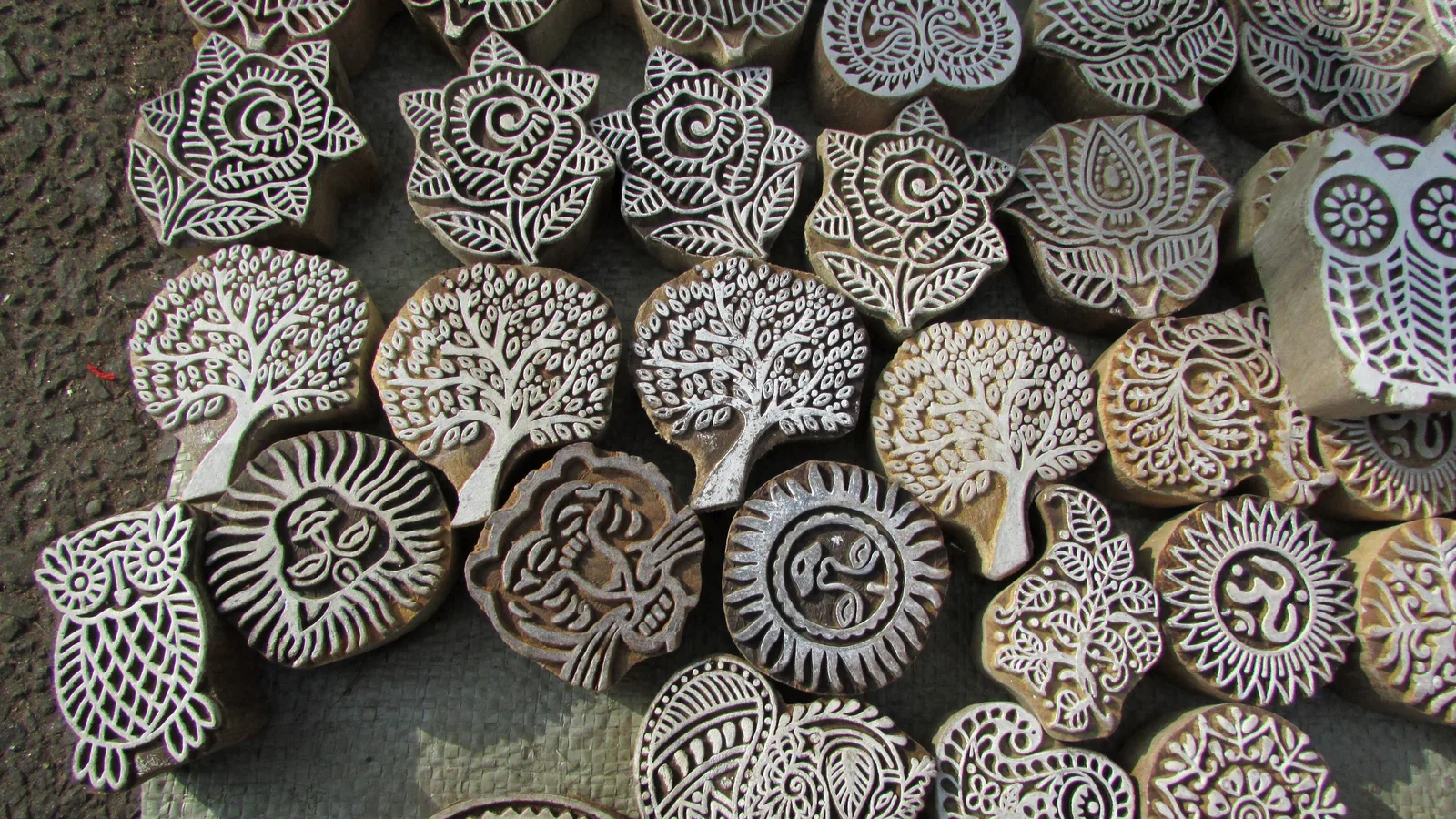
Sanganer prints usually have bright, fine patterns on a white or pale ground. Small flowers, buds and creepers repeat across the cloth, each colour stamped with its own block and lined up by the printer's eye. The GI registry entry for Sanganeri Hand Block Printing lists the Calico Printers Cooperative Society on Main Road, Sanganer, as the applicant. The application was filed on 2 December 2008 and the certificate is dated 19 March 2010.
Several workshops in and around Sanganer take visitors and run paid demonstrations or half-day classes. They generally ask you to book a slot rather than turn up. Prices vary widely by workshop and group size, so compare a couple before you commit.
The Kagzi papermakers
Sanganer is also one of north India's best-known centres for handmade paper. According to the Kumarappa National Handmade Paper Institute, the Kagzi community's history in the trade goes back to the 14th century, and in the 16th century Raja Man Singh of Amber settled them in Sanganer on the bank of the Saraswati river, where clean water was easy to find. The same account says Mahatma Gandhi helped revive the craft in the 1930s by buying their paper in bulk for his ashram.
Most paper is made from cotton rag, with some from silk and banana fibre. Today the work is mostly done in larger units rather than homes. If you want to buy paper, notebooks or cards, the factory showrooms are a better bet than small shops in the market.
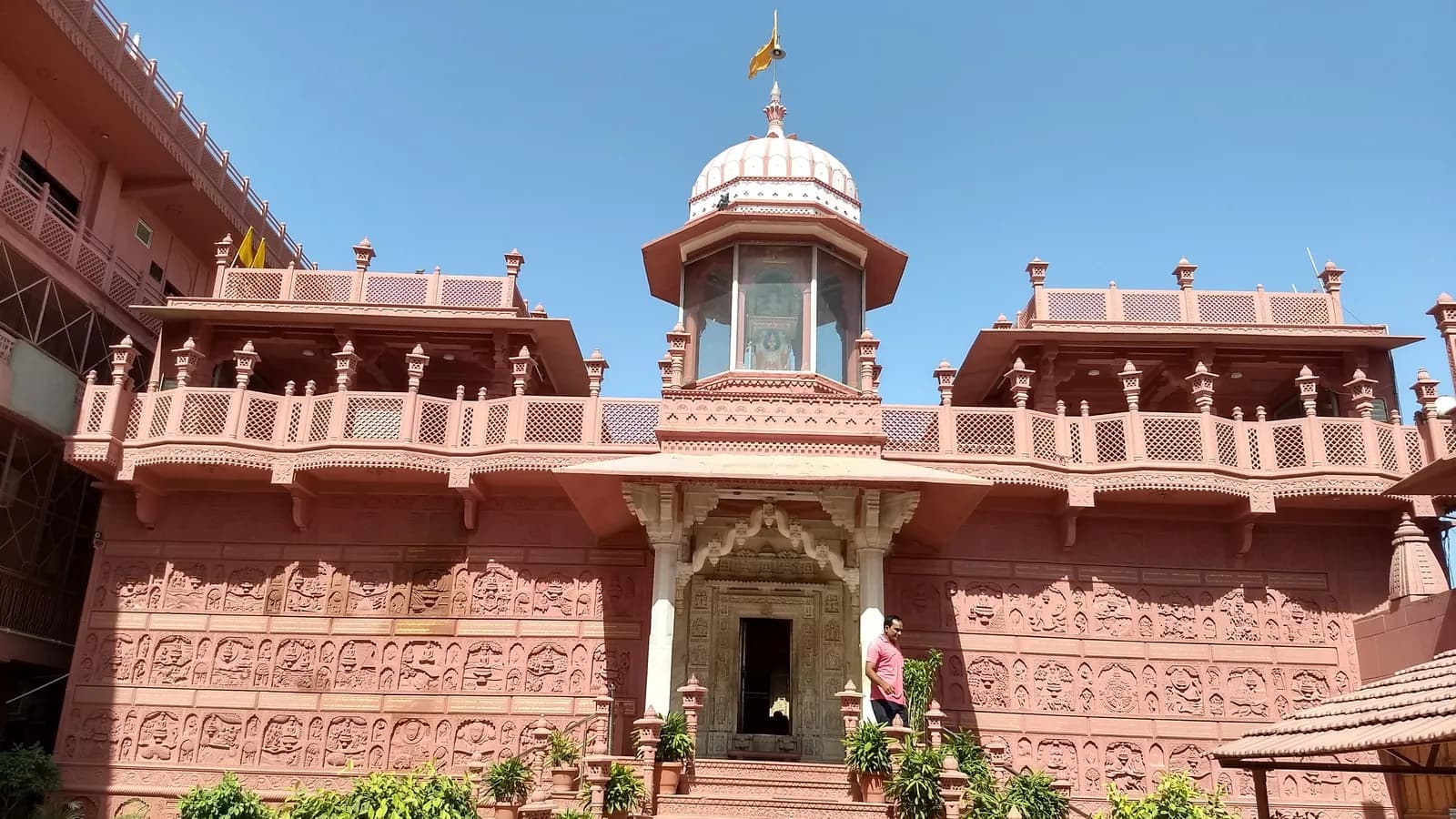
Sanghiji, the red-stone Jain temple
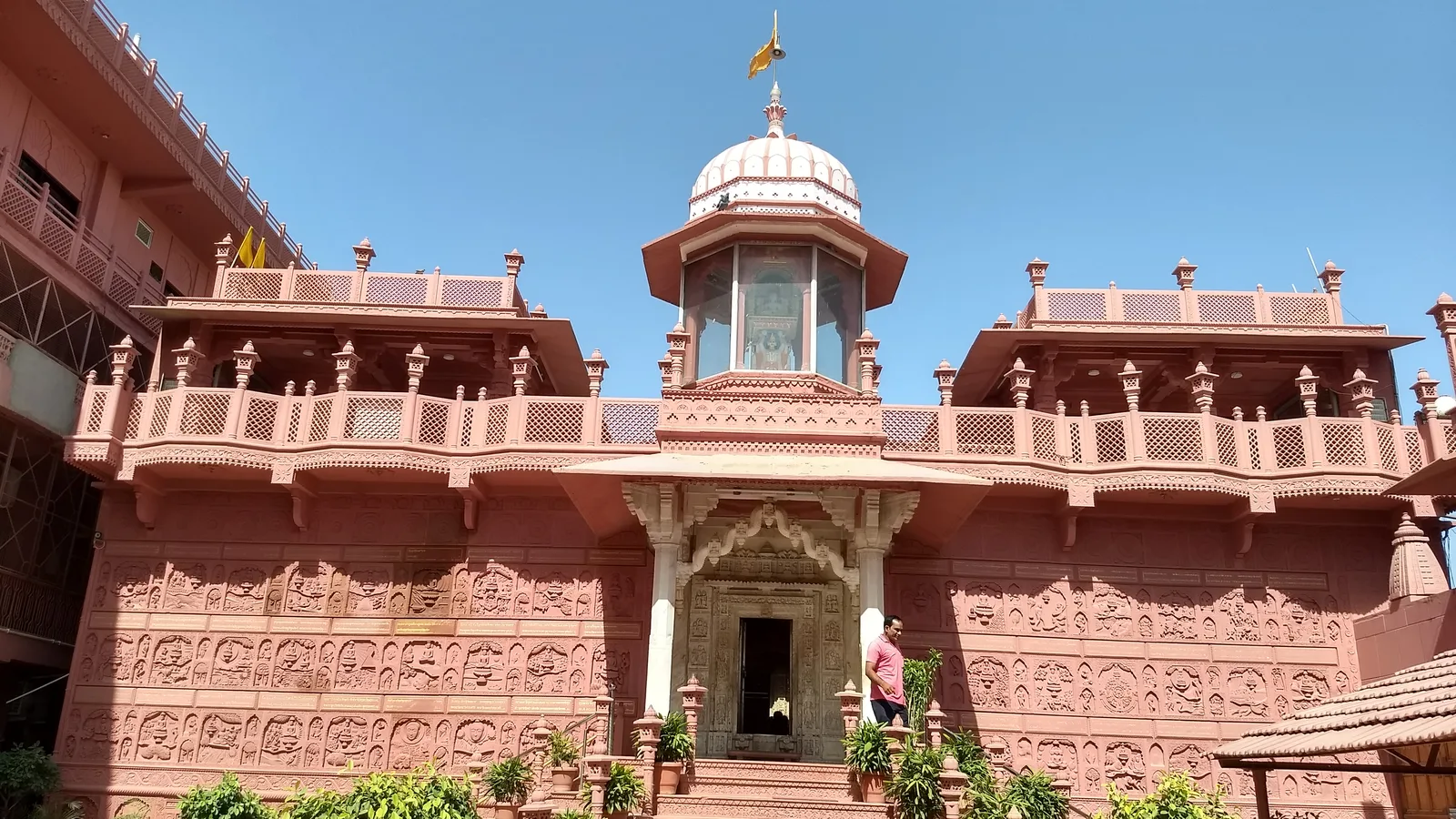
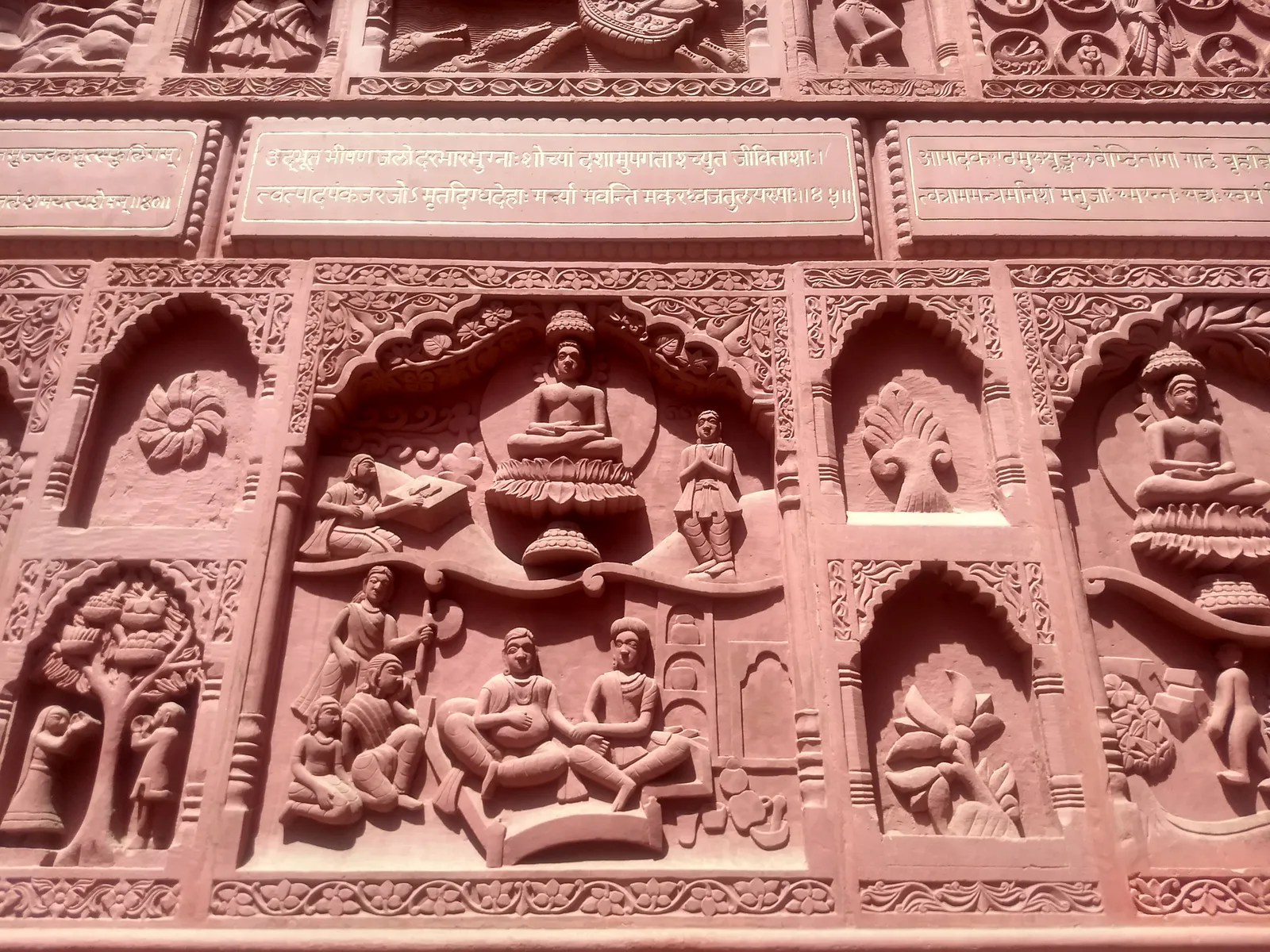
A short walk from the paper units is the Shri Digamber Jain Atishaya Kshetra Mandir, better known as Sanghiji. It is built of red stone and covered in carving, and its principal deity is Rishabhanatha (Adinatha), the first Tirthankara. An inscription dated V.S. 1011 on one of its toranas places the temple's last building phase in the 10th century CE.
The temple has seven underground levels that stay closed to visitors. By tradition, only a Digambara ascetic who renounced the world as a child may enter them and bring out the idols kept there, and only for a set period announced in advance. What you can see above ground is more than enough: carved walls, gateways and shrines in warm red stone.
Sanghiji is an active place of worship. Dress modestly, remove your shoes where asked, and follow the rules posted at the entrance, including any on leather items and photography. The temple complex also has a dharamshala and a bhojanalaya (dining hall).
Stop 2: Bagru, mud, indigo and drying yards
From Sanganer, the ride to Bagru runs west on NH52 and then along the Jaipur–Kishangarh Expressway (NH48) towards Ajmer. Bagru is a small town about 32 km south-west of Jaipur. Its printers belong largely to the Chhipa community, and the GI registry entry for Bagru Hand Block Print lists an artisans' society based in Chhipa Mohalla, Bagru, as the applicant. That application was filed on 10 August 2009 and the certificate is dated 11 May 2011.
What makes Bagru different
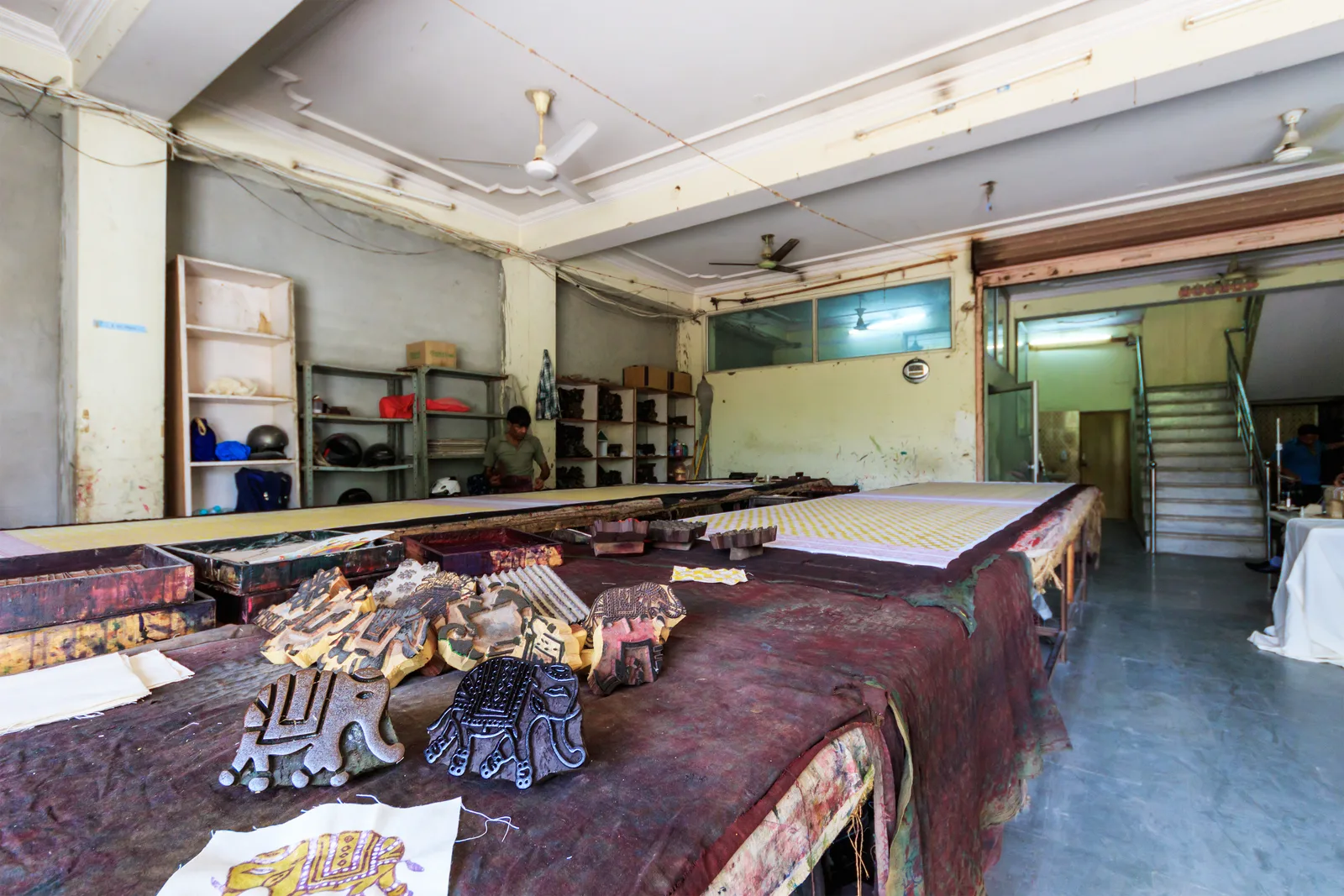
Where Sanganer is light and fine, Bagru is darker and earthier. Its best-known technique is dabu, a mud-resist method. A paste made traditionally from black clay, lime, gum and wheat chaff is printed onto the cloth where the dye should not reach, and sawdust is sprinkled on the wet paste to set it. The cloth then goes into the dye vat, very often indigo, and the paste is washed away to reveal the pattern. Repeating the cycle builds up two- or three-tone designs.
Traditional Bagru colours are made from natural sources: black from iron, red from madder with alum, and blue from indigo. Because each length of cloth is printed, resisted, dyed, washed and dried in stages, a single piece can take several days.
Booking a hands-on session
Bagru has several family workshops that welcome visitors. One of them, Jai Texart on Narvaria Road, lists on its website a two-hour factory visit with hands-on printing, priced from ₹600 for a bandana to ₹1,100 for a scarf, and says it is open every day except on Purnima (full-moon days). Another, Bagru Hastkala Printers, lists a two-day dabu and natural-dye workshop. Both ask visitors to book ahead. These details were on their sites on 21 October 2026; check directly before you ride.
The next full moon falls on 26 October 2026, so if you are planning the ride around then, confirm the workshop is open that day.
A suggested one-day plan
- 8:00 am: Collect your bike, check the fuel, tyres and brakes, and leave Jaipur before the office rush.
- 8:30 to 11:00 am: Sanganer. Visit Sanghiji first while it is quiet, then walk to the paper units and a printing workshop.
- 11:00 to 11:45 am: Ride on to Bagru. Stop for water and a snack on the way.
- Noon to 3:00 pm: Bagru. Watch the printing and dyeing, take a short hands-on session if you have booked one, and eat in town.
- 3:30 to 4:30 pm: Ride back towards Jaipur on the Ajmer road, aiming to be in the city well before sunset, which is a little before 6 pm in late October.
If you would rather keep the day short, do Sanganer alone. It is close to the airport and the southern colonies, and you can be back in the old city by lunch.
Riding tips for this route
- Helmets for both riders. They are required by law in India, and the expressway section is fast.
- Keep left on NH48. Trucks and buses run fast on the expressway. Stay in the left lane, ride at a steady pace and avoid riding it after dark.
- Carry your licence and booking details. Your driving licence must cover the type of two-wheeler you rent.
- Fuel up in the city. There are fuel stations along the main roads, but it is easier to start full.
- Pack for the yards. Dyeing areas are wet and dye-stained. Wear shoes you do not mind getting muddy and carry a small bag for purchases.
- Ask before photographing people. These are working homes and workshops, not museums.
How to tell real hand block prints from copies
Screen-printed and machine-printed fabric is often sold as hand block work, in Jaipur's bazaars and sometimes near the printing towns too. A few simple checks help:
- Look for small irregularities. Hand printing leaves slight variations in colour and tiny gaps or overlaps where blocks meet. Perfectly even repeats over a long length usually mean a machine.
- Check the back. On hand-printed cotton, colour usually shows through to the reverse side.
- Buy where you can see the work. A workshop where you have watched the printing is the safest place to shop.
- Ask about GI. Only registered authorised users may sell under the protected GI names. A seller who is one should be able to tell you so.
Choosing your bike
For this route, a 110 cc scooter is enough. The roads are flat, the distances are short, and a scooter's under-seat storage is handy for fabric and paper. If you are riding two-up with luggage, or plan to add more kilometres, consider something with more power.
On 21 October 2026, the lowest-priced two-wheeler on the Hire N Ride Jaipur page was a Honda Activa at ₹639 for one day (10% off ₹710), with 120 km a day included, a ₹1,000 security deposit, home delivery within 5 km and roadside assistance listed. Prices and availability change, so check the page when you book.
Want a longer ride another day? Our Jaipur bike morning to Sambhar Salt Lake heads west across open country to India's largest inland salt lake.
To plan the rest of your trip, start with our Rajasthan self-drive and bike rental guide.
Conclusion
Sanganer and Bagru show a side of Jaipur that the bazaars only hint at: carved teak blocks, vats of indigo, drying cloth, handmade paper and a 10th-century temple in red stone. On a bike, the whole loop fits comfortably into a single day, leaves time for a hands-on session, and has you back in the city before dark with something you watched being made.
Ready to ride? Book a bike rental in Jaipur with Hire N Ride and plan your block-print day.