By Manjot Kaur · 20 October 2026
Haryana's largest wetland was never meant to be a bird sanctuary. Bhindawas was built to hold spare water. The Jhajjar district administration says the lake was made to store the excess water of the Jawaharlal Nehru canal whenever the pumps of its lift canal system stopped during a power failure. Over the years that overflow store turned into a lake ringed by an embankment, and the birds found it. Today it is a protected sanctuary and a Ramsar wetland of international importance, a short drive south of Rohtak.
Late October is when the season starts. On 13 October 2026, Dainik Jagran reported that migratory birds from Siberia, Russia, Kazakhstan and Central Asia begin reaching Haryana's wetlands in the last week of October, and that their numbers grow through November and December. This guide pairs the lake with two more stops in Jhajjar district: the goddess temple at Beri, and a cluster of Mughal-era tombs in Jhajjar town with a love story attached. If you want to go soon, book a self-drive car in Rohtak and use the plan below.
Key Takeaways
- The loop: Rohtak to Beri is about 25 km, Beri to Bhindawas about 26 km, Bhindawas to Jhajjar about 20 km and Jhajjar back to Rohtak about 35 km. That is roughly 105 km by map routing, plus the drive around the lake.
- The lake: the district administration says a 12 km vehicle track goes all the way around Bhindawas. The Ramsar listing gives the wetland's area as 412 hectares.
- The birds: arrivals start in the last week of October and build through November and December. Birding guides name December and January as the best months. A late-October visit catches the first arrivals and the resident species.
- Timing: birding guides list winter hours of 6:30 am to 5 pm, but there is no official timetable online, so check at the gate. Sunset at Bhindawas is about 5:49 pm on 20 October and 5:39 pm on 31 October.
- Beri: the goddess is moved to the outer temple every morning and back to the inner temple at noon, so go early.
- Car: on 20 October 2026, the Hire N Ride Rohtak page listed self-drive cars from ₹2,280 for one day.
Why a canal's spare water became a bird lake
The Ramsar information sheet describes Bhindawas as a human-made wetland in a saucer-shaped dip in the land. Its water comes through an escape channel from the Jawaharlal Nehru canal, and surplus water leaves through a drain at the south-east corner. A 12 km raised bund separates the lake from the farmland around it, and six villages surround it: Bilochpura, Shahjanpur, Nawada, Kanwah, Chadwana and Reduwas.
The Haryana Wildlife Department calls Bhindawas Wildlife Sanctuary the largest wetland in the state. It was declared a protected area in 1986. The Government of India declared it a bird sanctuary on 3 June 2009, according to the district administration. On 25 May 2021 it was listed as a Ramsar site, a wetland of international importance.
The Ramsar sheet explains why it matters. Bhindawas sits on the western route of migratory birds, and many of them stop here on the way to Keoladeo National Park at Bharatpur. More than 250 bird species use the sanctuary over the year. It supports more than ten globally threatened species, including the Egyptian vulture, steppe eagle, Pallas's fish eagle and black-bellied tern. The sheet also says the lake regularly holds more than 1.7% of the regional population of greylag geese and more than 2% of the Indian cormorant population.
What you can expect to see in late October
Be realistic about timing. A late-October visit falls at the start of the season, not at its peak. The Dainik Jagran report names the main migrant waterbirds that reach Haryana's wetlands: northern pintail, northern shoveler, common teal, gadwall, Eurasian wigeon, common pochard, mallard, bar-headed goose, greylag goose and ruddy shelduck. It also notes that only a local survey can confirm which species are at a particular lake on a particular day. Birding guides name December and January as the best months at Bhindawas.
Last winter's count shows what the lake can hold, and the pressures it faces. The Asian Waterbird Census on 17 January 2026 recorded 9,483 waterbirds of 52 species at Bhindawas, The Times of India reported. They included northern shovelers, common teals, gadwalls and greylag geese, and three threatened species: the greater spotted eagle, common pochard and ferruginous duck. The ornithologist who led the count said large parts of the wetland had dried up, water hyacinth covered some of the surface, and migration had been lower that winter.
Resident birds are there all year. The census report mentions the Indian spot-billed duck, common moorhen and purple swamphen. In October you can expect to see these birds along with herons, egrets and cormorants on the open water.
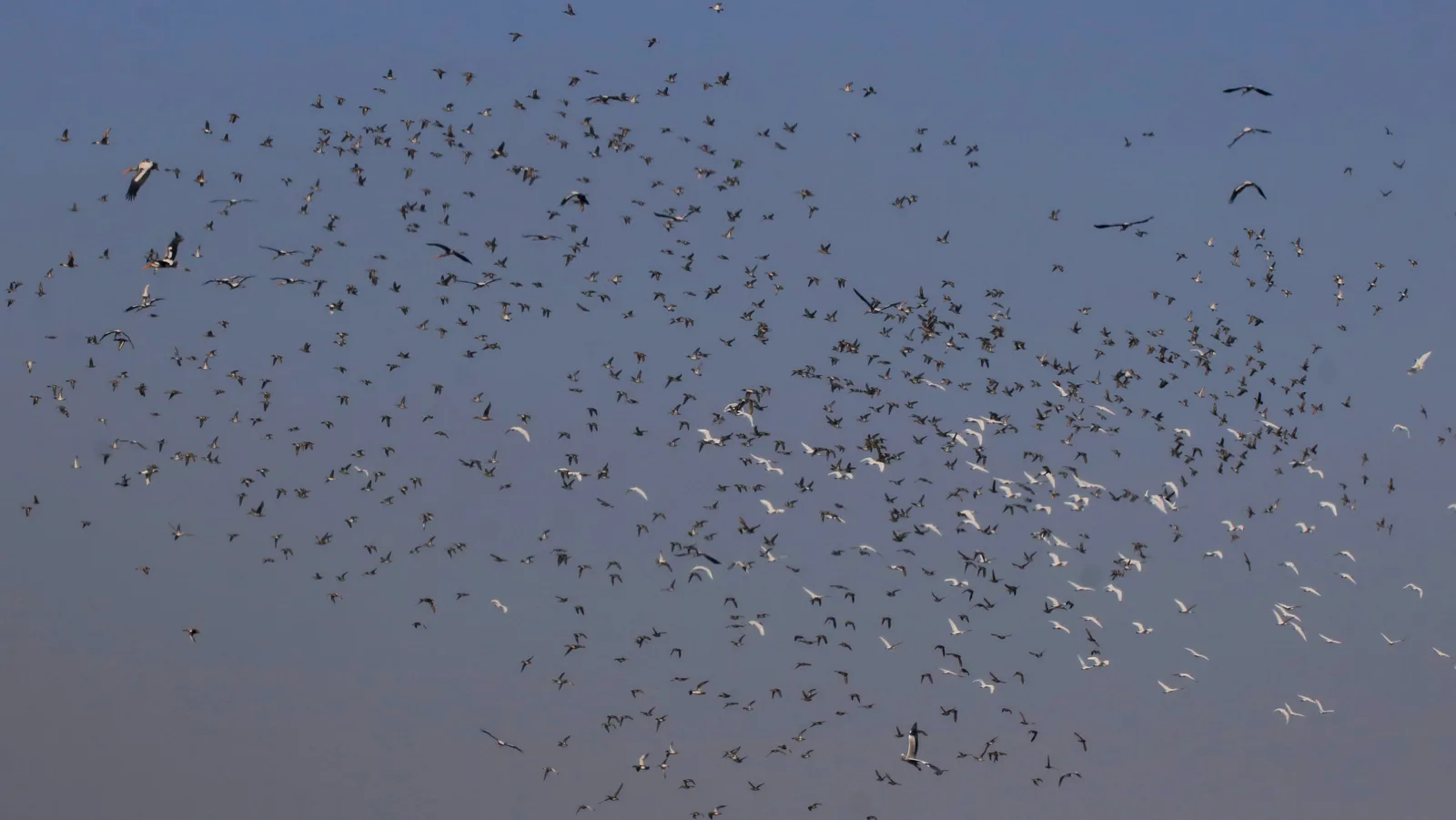
Bhindawas is not the only water body in the area. In January 2026, The Tribune quoted Rohtak's Deputy Conservator of Forests as saying that Sampla, Dighal, Mandothi and other village wetlands were also full of migrants. The smaller Khaparwas Wildlife Sanctuary lies right next to Bhindawas.
The route: Rohtak, Beri, Bhindawas, Jhajjar and back
All four places are on paved roads in flat country. Driving time for the loop is about two hours by map routing, so most of the day goes on the stops. Going in this order puts Beri in the morning, which suits the temple, and gets you to the lake while the light is still soft.
- Rohtak to Beri: about 25 km on NH352 and local roads, roughly half an hour.
- Beri to Bhindawas: about 26 km south through farming villages, roughly 35 minutes.
- Around the lake: the 12 km track around the bund. Allow two to three hours if you stop often.
- Bhindawas to Jhajjar: about 20 km east. Listings usually put the sanctuary about 15 km from Jhajjar town.
- Jhajjar to Rohtak: about 35 km north on NH352, roughly half an hour to 40 minutes.
If you only want the lake, Rohtak to Bhindawas via Jhajjar is about 54 km, or about 50 km via Beri. A half day is enough for that, as long as you leave early.
Stop 1: Mata Bhimeshwari Devi temple, Beri
Beri is a market town in Jhajjar district, and its goddess temple is the best-known shrine in the area. The district administration tells the local legend. Before the Mahabharata war, Krishna asked Bhima to bring his family goddess from the Hinglaj mountain to the battlefield at Kurukshetra. She agreed to go on one condition: if Bhima put her idol down on the way, she would go no further. Bhima set the idol down under a beri (jujube) tree, and that is where she stayed. Later, the story goes, Gandhari built a temple at the spot. If the story makes you curious about Kurukshetra itself, our guide to a day at Kurukshetra by car covers the battlefield sites.
There are two temples at Beri, an outer one and an inner one. According to the district administration, the idol is carried to the outer temple every morning and returned to the inner temple at noon, a custom said to go back to the sage Durvasa. Arrive in the morning to see the goddess in the outer temple. Dress modestly, leave your shoes where the others do, and expect large crowds on festival days.
Stop 2: the bund road around Bhindawas
The Jhajjar district page on Bhindawas says the visit "does not involve too much walking", because a 12 km vehicle track goes right around the lake. It also notes that you can often see water birds along the canal before you even reach the sanctuary. Birding guides mention two watchtowers on the edge of the lake that look over the open water.
Before you drive on, ask at the gate whether cars are allowed on the track that day, what it costs, and when it closes, because none of this is published on an official page. On the bund, drive slowly, stop without blocking the track and switch the engine off. Keep your voices low, do not use the horn, and take any litter home.
Bring binoculars. The birds tend to stay well out on the water and on the small islands, so photographers will want a long lens. If you come back in December or January, wrap up well for cold, foggy mornings.
Stop 3: Jhajjar's tombs and Bua Wala Talab
East of Jhajjar town, on the road towards Bahadurgarh and Delhi, is a group of Mughal-era tombs and mosques. Haryana Tourism dates them to 1594–1626, the reigns of Akbar, Jahangir and Shah Jahan. It describes their style as an older Pathan one, similar to the Sharqi monuments of Jaunpur, and suggests the site was a family graveyard for local chiefs and nobles. The group is protected by the Government of India.
One of the tombs carries a love story. In the legend told by Haryana Tourism, Bua, the daughter of an official named Mustafa, was attacked by a tiger in the forest and saved by Hasan, a poor woodcutter. They fell in love. Her father reluctantly agreed to the match but sent Hasan off to war, and Hasan was killed. Bua buried him beside the pond where the couple used to meet and built a tomb for him. She died two years later and was buried beside him. The pond is still called Bua Wala Talab.
The legend has some history behind it. The Tribune reports that a Persian inscription on the site said the "light tomb of Hasan Shahid" was built in Jahangir's time, which dates it to 1625. The same report says the tombs are under the Archaeological Survey of India but poorly kept. The pond is now part of a public park, Shaheedi Park, and has been renovated. Give it half an hour, and treat it as a quiet stop rather than a grand monument.
Optional: the Gurukul Jhajjar museum
Haryana Tourism calls the archaeological museum at Gurukul Jhajjar the biggest museum in Haryana. It was founded in 1959 by Swami Omanand Saraswati, who collected antiques from many parts of the country. Haryana Tourism highlights its old coins, stone idols, a wooden chain carved with no joints and a "flexible" stone. Published opening hours and closing days do not agree, so phone the Gurukul before you plan around it.
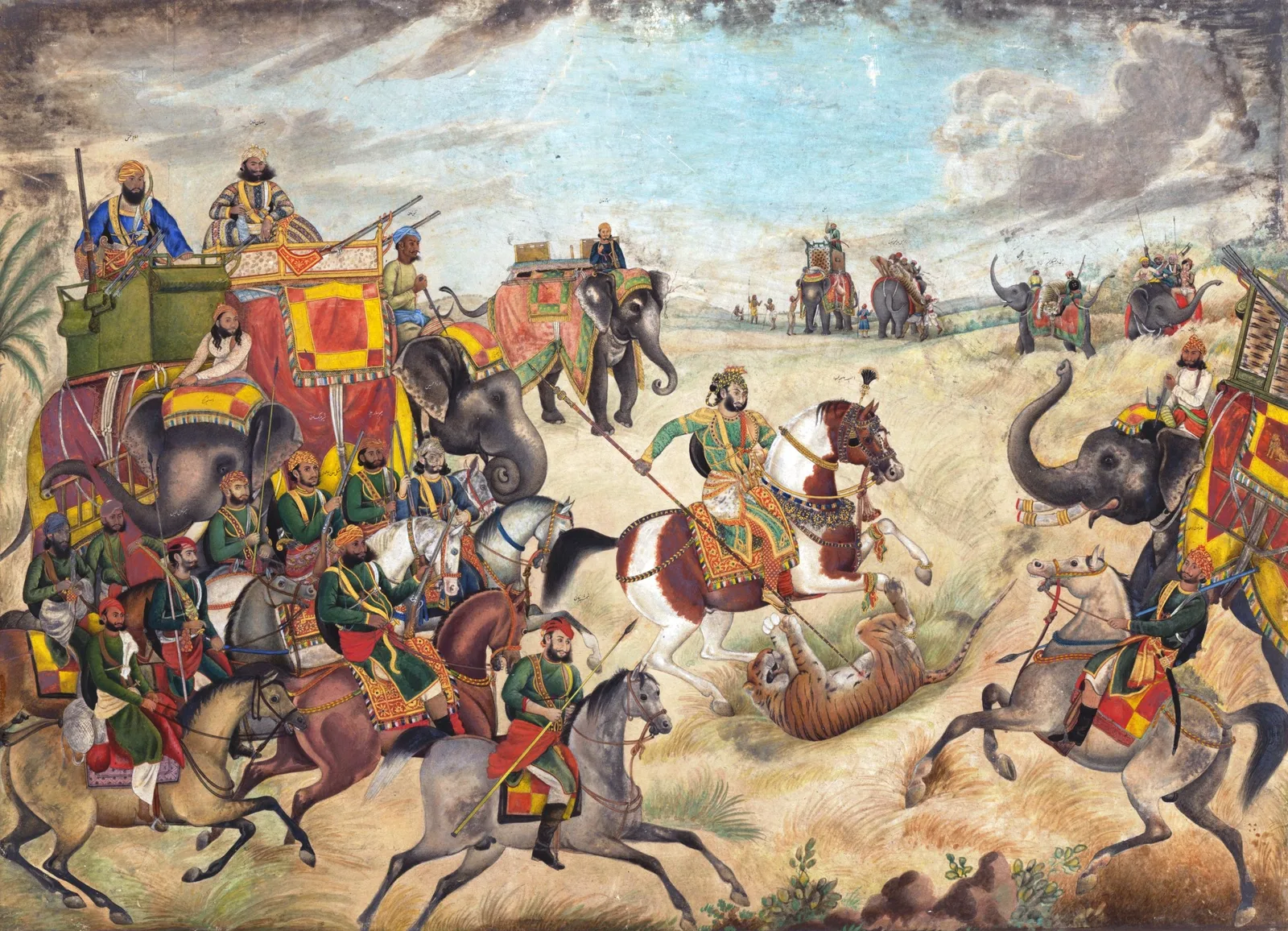
Jhajjar's later history is in that painting above. According to the history on Wikipedia, the British East India Company granted the Jhajjar region to Najabat Khan after the war of 1803. His family held it until 1857, when the last nawab, Abdul Rahman Khan, was hanged for taking part in the uprising and the estate was confiscated. The Victoria and Albert Museum identifies him as the rider spearing the tiger in the centre of the hunt painting.
A suggested day plan
- 7 am: pick up the car in Rohtak and leave for Beri. Have breakfast in Beri or on the way.
- 7:45 am: visit the Bhimeshwari Devi temple while the goddess is in the outer temple.
- 9 to 11:30 am: Bhindawas. Ask at the gate, then drive slowly around the bund with stops at the watchtowers.
- 12:15 pm: lunch in Jhajjar town.
- 1:30 to 3 pm: the group of tombs, Bua Wala Talab and, if it is open, the Gurukul museum.
- 3:30 pm: drive back to Rohtak on NH352, before the evening traffic and well before sunset.
Prefer the evening light? Reverse the loop and keep the lake for the afternoon, then drive back to Rohtak on NH352 after it closes.
Tips for the drive
- Fuel: fill up in Rohtak or Jhajjar. The Rohtak page says cars come with limited fuel, and you return them at the agreed level.
- Farm traffic: village roads carry tractors, trolleys and cattle, especially at harvest time. Do not judge your timing by highway speeds.
- Air and fog: late October is the start of the haze season in the National Capital Region, which includes Rohtak and Jhajjar. Check the day's air quality and any restrictions on the CAQM website. In winter, the Rohtak page warns that fog can cut visibility on national highways, especially early in the morning.
- Documents: carry your original driving licence and a government photo ID. The Rohtak page lists a minimum age of 21.
- Kit: binoculars, water, snacks and a hat. Plan to be self-sufficient at the lake.
Choosing your car
The whole route is on paved roads in flat country, so a hatchback is all you need. On 20 October 2026, the Hire N Ride Rohtak page listed four self-drive cars. The lowest one-day rate was ₹2,280, for a Maruti Suzuki Swift or a Hyundai i20. A Maruti Suzuki Fronx with a petrol/CNG option was ₹2,352. The listings showed a ₹1,000 security deposit and doorstep delivery within 2 km. Rates and availability change, so check the live page before you book.
Want more drives from Rohtak? Our earlier guide goes west to Hansi's fort and the Rakhigarhi mounds. If you would like to compare wetlands, our Sultanpur drive from Gurugram covers another bird lake on the same Sahibi river corridor.
Conclusion: come for the first birds, stay for the stories
A canal's spare water became Haryana's largest wetland, and a pond where two lovers met became a small landmark of Jhajjar. In one easy loop from Rohtak you get the goddess at Beri, the first winter ducks on the lake, and a Mughal-era love story by the roadside. With a self-drive car rental in Rohtak, you choose when to start, where to stop and how long to watch the water.
Ready to go? Book a self-drive car in Rohtak, pack your binoculars, and plan to be at Beri before noon.
About the author: Manjot Kaur writes road-trip and self-drive guides for Hire N Ride. She checks distances, official timings and the latest local news, so renters know what is open before they set off.