By Manjot Kaur · 17 October 2026
Udaipur exists because of Chittorgarh. After Akbar's army took the great hill fort in 1568, the rulers of Mewar moved their capital west into the Aravallis, to the lake city that Udai Singh II had begun building a few years earlier. Udai Singh himself had been born inside Chittorgarh's walls. So when you drive east from Udaipur to Chittorgarh, you are driving back to where the city's story began.
The trip is easy to do in a day. Chittorgarh is about 120 km away, mostly on a wide national highway, and the fort has a road running around its whole plateau, so a car is useful all day, not just for getting there. With a self-drive car rental in Udaipur, you can leave at sunrise, see the towers before the midday heat, and be back by dinner. Book a car in Udaipur for your date, then use the plan below.
Key Takeaways
- Distance: open-source routing (OSRM) puts the City Palace area of Udaipur about 120 km from Vijay Stambh inside the fort, around 1 hour 35 minutes without stops. Plan on two hours or more with traffic and a tea break.
- Route: leave Udaipur on NH48 and join NH27 east. Most of the drive is on NH27, which passes near Maharana Pratap Airport at Dabok on the way.
- Fort hours: India's tourism ministry lists the fort as open from sunrise to sunset. In the third week of October, sunset at Chittorgarh is a little after 6 pm.
- Don't miss: the seven gates on the climb, Vijay Stambh, Kirti Stambh, Gaumukh reservoir, Meera temple, Rana Kumbha's palace and Padmini's palace.
- Car: on 17 October 2026 the Hire N Ride Udaipur page listed a 2026 Maruti Suzuki Brezza Lxi at ₹3,526 for one day, with 270 km a day included and a deposit from ₹5,000.
Why Chittorgarh works as a day trip from Udaipur
Chittorgarh Fort is one of the largest forts in India. It sits on a hill about 180 metres above the plain and covers around 700 acres, with a perimeter wall roughly 13 km long. In 2013 UNESCO listed it as one of the six Hill Forts of Rajasthan, together with Kumbhalgarh, Amber, Ranthambore, Gagron and Jaisalmer.
That size is exactly why a car helps. The monuments are spread along a plateau several kilometres long, linked by a circular road. On foot in the sun, you would see half of it. By car, you can drive from one group of monuments to the next, park, walk around, and move on. If you have already done our Kumbhalgarh drive from Udaipur, Chittorgarh is the natural next fort: a different direction, a flatter road, and a very different kind of fort.
The drive: Udaipur to Chittorgarh by car
Start early. Sunrise in Udaipur is around 6:30 am in the third week of October. If you leave by 7 am, the city roads are quiet and the light on the Aravallis is soft. From the old city, head out towards the airport road and join the highway east. OSRM routes it along city roads and short stretches of NH58 and NH48, then more than 90 km on NH27 towards Chittorgarh, followed by a short run through the town to the foot of the fort.
NH27 is a busy highway with heavy truck traffic. Keep to the left lane unless overtaking, watch for cattle and two-wheelers near villages, and use the dhabas along the way for breakfast rather than stopping on the shoulder. Fuel up in Udaipur before you go so you don't have to search for a pump later.
Optional detour: Sanwaliya ji
Rajasthan Tourism lists the Sanwaliya ji temple at Mandfiya, near the Chittorgarh–Udaipur highway, as one of the region's most visited temples. It is a detour from the direct route, so it adds time and distance. If you want to include it, do it on the way back, and check the darshan timings before you go.
Seven gates up the hill
The road from the new town climbs more than a kilometre in a zig-zag up the western face of the hill. Near the base you cross an old limestone bridge over the Gambhiri river, carried on ten arches. Then the gates begin. Rana Kumbha, who ruled Mewar from 1433 to 1468, built the seven pols that guard the ascent. From the bottom up they are Padan Pol, Bhairon Pol, Hanuman Pol, Ganesh Pol, Jodla Pol, Laxman Pol and finally Ram Pol, the main gate.
Drive this part slowly. The road is narrow, the bends are tight and you will meet autos, buses and people walking. Jodla Pol is worth a second look: it is a "joined" gate, with its upper arch connected to the base of Laxman Pol above it. Each gate has heavy doors with pointed arches and notched parapets, built to slow down attackers. Today they mainly slow down traffic, so be patient.
Once you pass Ram Pol, you are on the plateau. A road loops around the fort, linking the gates and monuments. Parking is available near the main monument groups. Follow the signs and any directions from staff, and pay any parking or vehicle fees that apply.
What to see inside, in a sensible order
Rana Kumbha's palace
Start near the entrance with the ruined palace of Rana Kumbha, one of the largest monuments in the fort. This is where Udai Singh II, the founder of Udaipur, was born. Local tradition says his nurse Panna Dai saved him by swapping her own son into his bed. The palace is mostly roofless now, but you can still walk through its courtyards and see the cellars below. Nearby is the Fateh Prakash Palace, now a government museum. Rajasthan Tourism lists its timings as 9:45 am to 4:45 pm, with tickets at ₹20 for Indian adults and ₹10 for children.
Vijay Stambh, the Tower of Victory
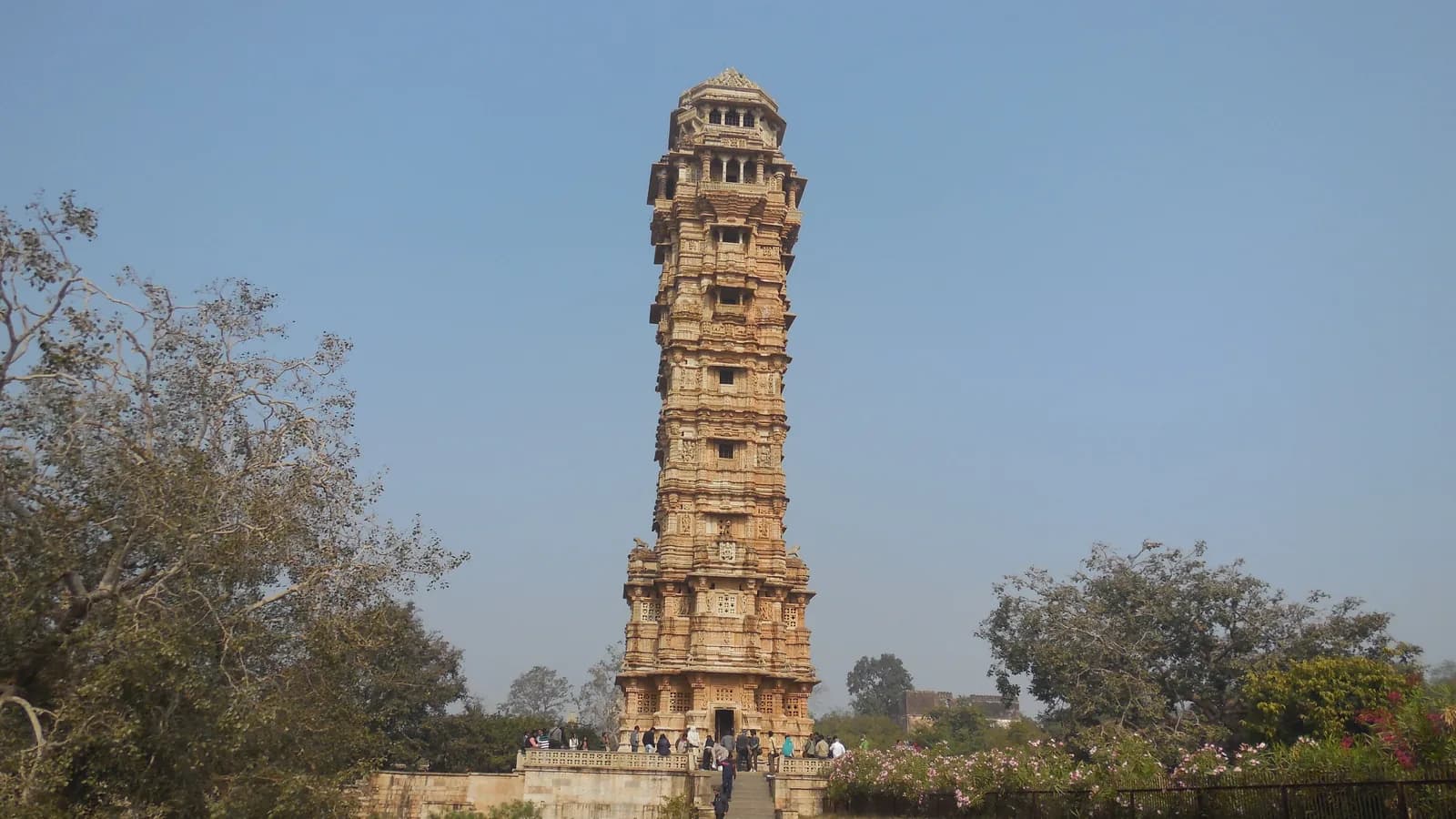
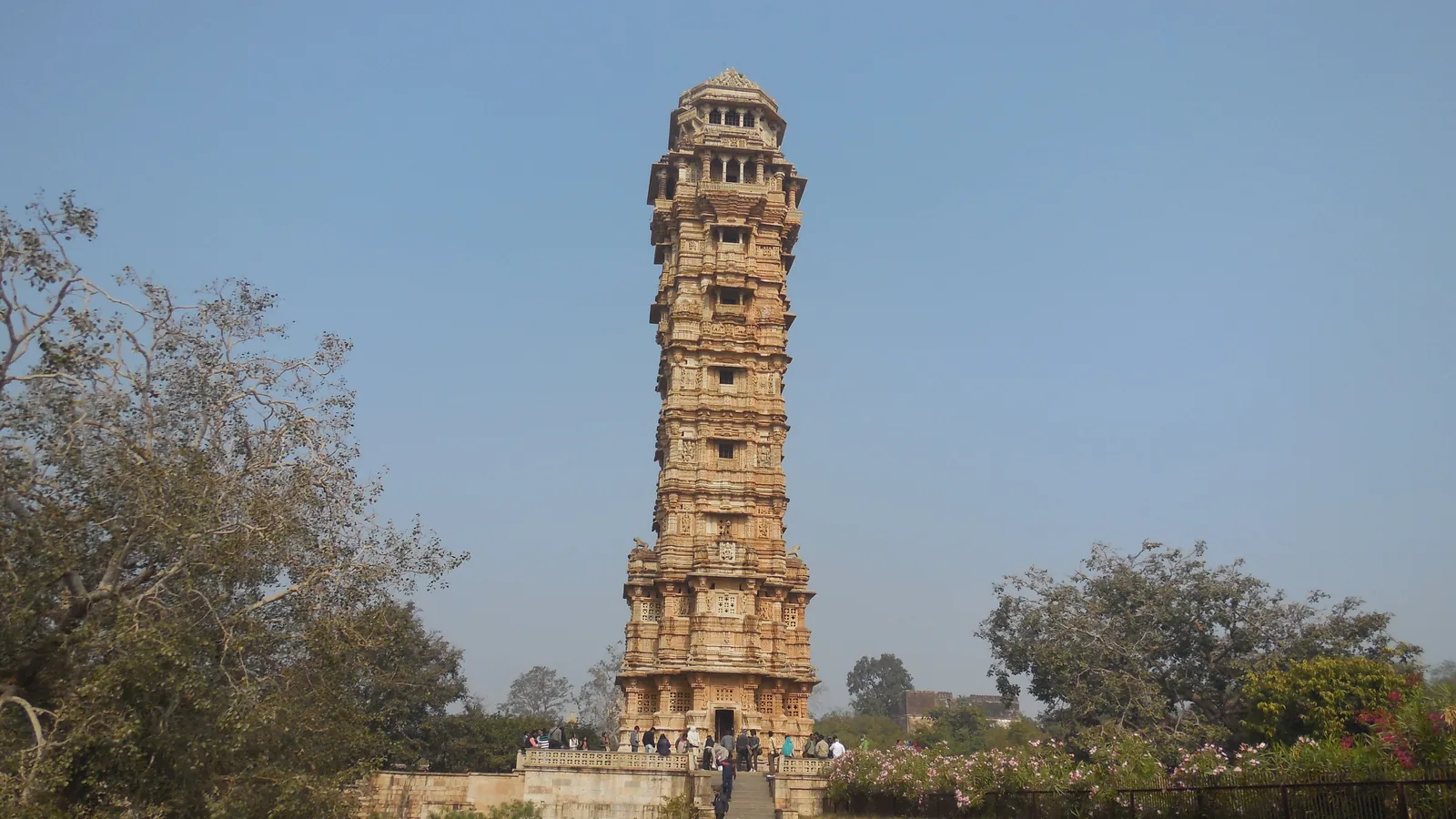
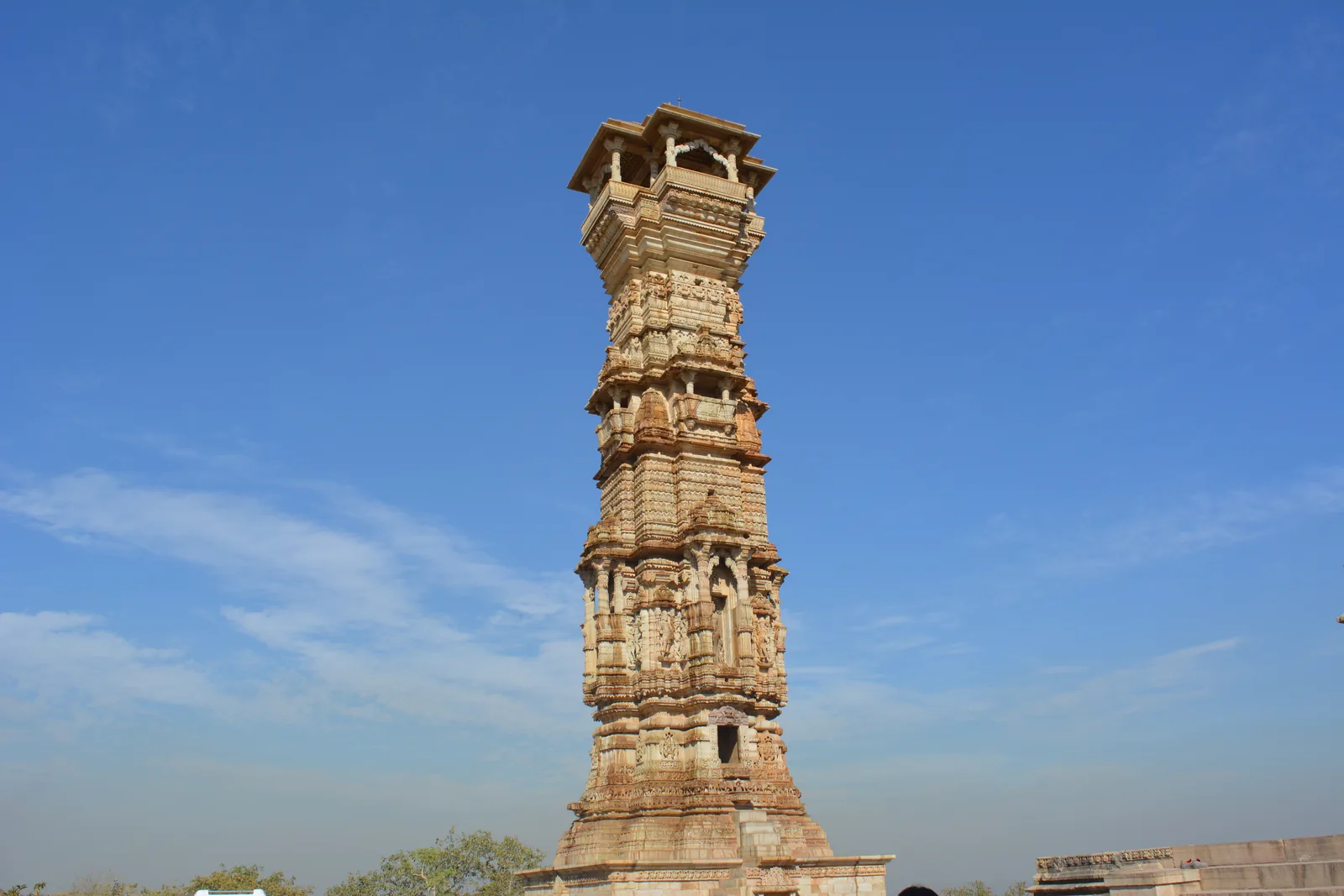
A short drive brings you to the fort's symbol. Rana Kumbha built Vijay Stambh in the 15th century to mark his victory over the Sultan of Malwa. Rajasthan Tourism dates it to 1440–1448. It rises about 37 metres in nine storeys, built of sandstone and marble and covered in carved figures of Hindu gods. A narrow internal staircase of 157 steps climbs to the eighth floor. Whether the stairs are open on the day depends on the staff, so ask at the tower. The tower is lit up in the evening, which is one reason some visitors stay late.
Meera temple and Kumbha Shyam temple
Next to Vijay Stambh stand two temples in one compound. The larger is the Kumbha Shyam temple, and the smaller is associated with Meera Bai, the poet-saint who lived at Chittorgarh and sang her devotion to Krishna. Dress modestly, take off your shoes where asked, and keep your voice down if a prayer is going on.
Gaumukh reservoir
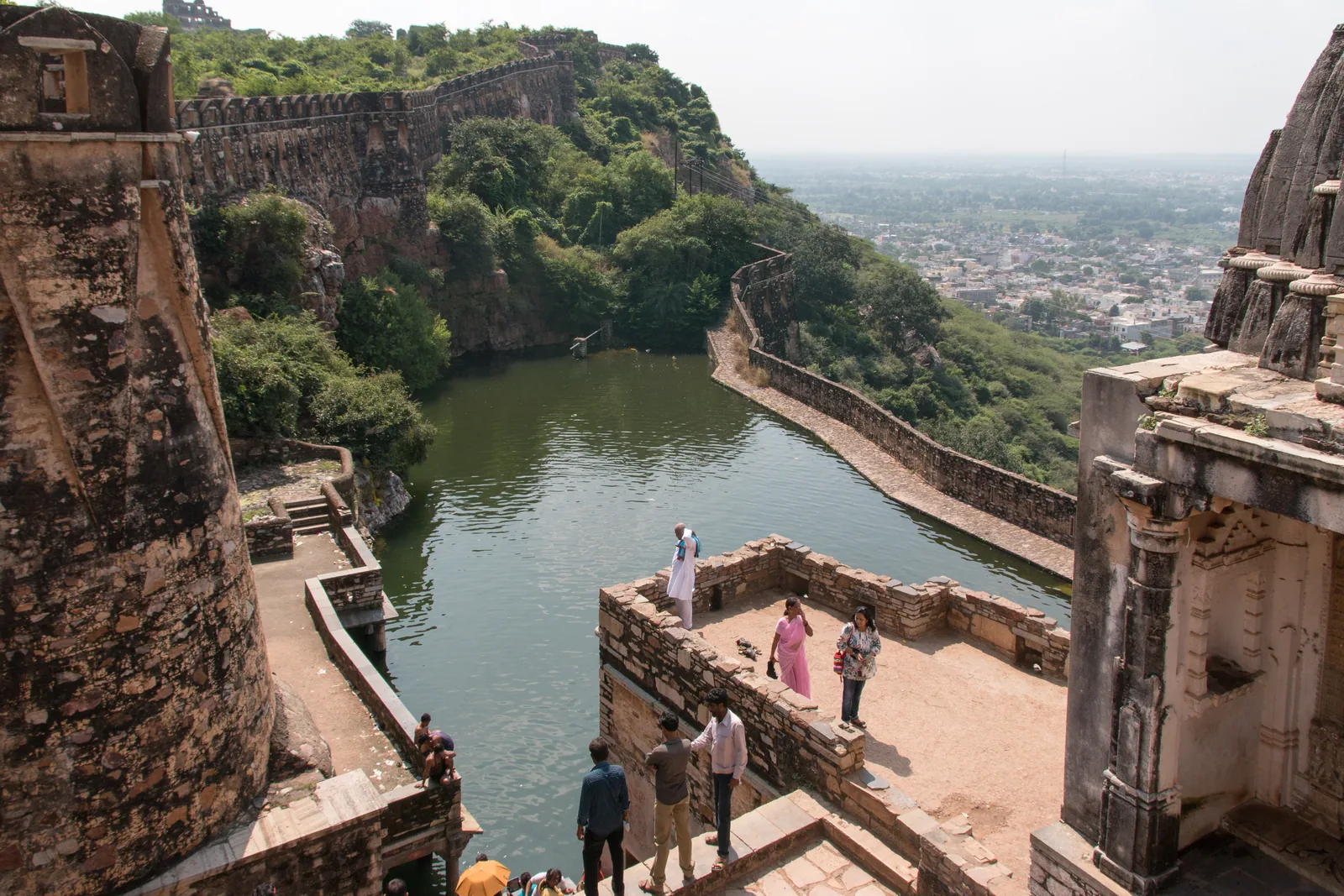
Below the western wall, a spring flows through a rock carved like a cow's mouth into a deep tank. This was the fort's main water source during its sieges. Today people come to feed the fish. Take the steps down slowly, as they can be slippery near the water.
Padmini's palace and Kalika Mata temple
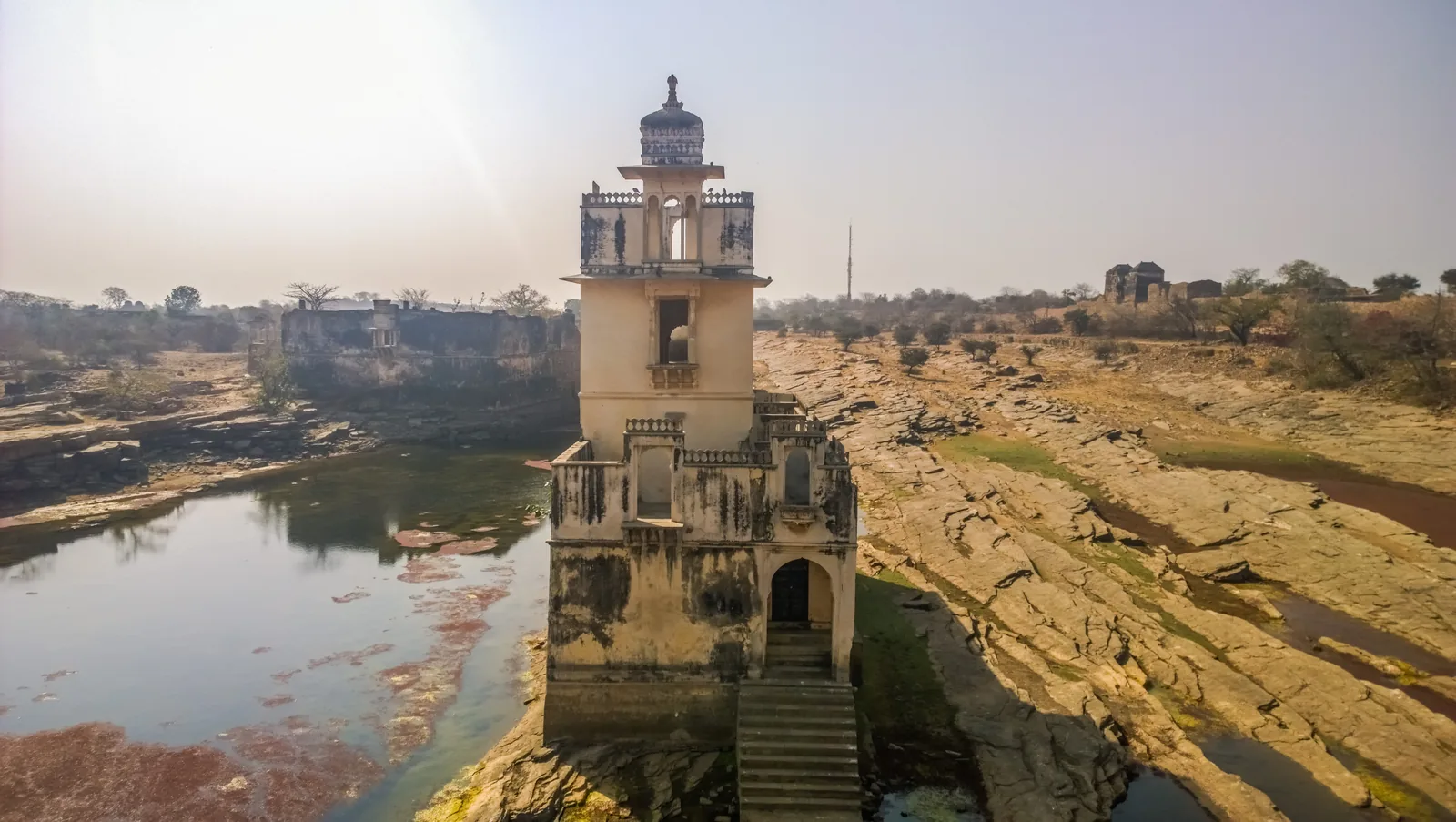
Drive south along the loop to Rani Padmini's palace, a white three-storey building with a pavilion in a pool. The building you see is a 19th-century reconstruction. The story of Padmini and Alauddin Khalji's siege of 1303 is one of Rajasthan's best-known legends, but many historians treat it as legend rather than record. Either way, the palace and its pool are a calm place to pause. Across the road is the Kalika Mata temple, originally an 8th-century sun temple that was later rebuilt and dedicated to the goddess Kali.
Kirti Stambh, the Tower of Fame
Finish on the eastern side of the plateau at Kirti Stambh. This Jain tower is about 22 metres tall, smaller and older than Vijay Stambh, and is thought to date from the 12th century. It is dedicated to Adinath, the first Jain tirthankara, and is covered in carved figures. The Jain temples nearby are worth a few minutes too. From the walls here you can see the plain stretching east, which makes it clear why the hill was so hard to attack.
Light and sound show: stay late or head home?
Every evening the fort puts on a light and sound show about its history, run by the Rajasthan tourism corporation. India's tourism ministry lists it at 7 pm to 8 pm daily in Hindi and English, at ₹150 for adults and ₹75 for children, plus 18% GST. It is a good way to end the day, but it means leaving Chittorgarh after 8 pm and driving about two hours back to Udaipur in the dark on a highway full of trucks. If you want to see the show, consider staying one night in Chittorgarh and driving back the next morning. If not, leave the fort before sunset and you'll be back in Udaipur around 8 pm.
A sample day plan
- 6:45 am: pick up your car in Udaipur. Check the tyres, lights and fuel, and note any existing scratches at handover.
- 7:00 am: leave the city via NH48 and join NH27 east.
- 8:00 am: breakfast at a highway dhaba.
- 9:30 am: drive up through the seven gates to Ram Pol.
- 9:45 am to 11:30 am: Rana Kumbha's palace, the museum, Vijay Stambh and the Meera temple.
- 11:30 am to 1:00 pm: Gaumukh reservoir and Padmini's palace.
- 1:00 pm to 2:30 pm: lunch in Chittorgarh town and some rest out of the sun.
- 2:30 pm to 4:30 pm: Kirti Stambh, the Jain temples and a final drive around the loop.
- 4:45 pm: drive down and head back towards Udaipur, reaching the city around dusk or soon after.
Choosing your car and staying within the limit
The round trip from Udaipur is about 240 km, plus the drive up the hill and the loop inside the fort. That fits within the 270 km a day shown on the Udaipur listing. If you add the Sanwaliya ji detour or extra town driving, keep an eye on the odometer. On 17 October 2026, the Hire N Ride Udaipur page showed:
- Maruti Suzuki Brezza Lxi (2026): petrol/CNG, manual, ₹3,526 for one day, with 270 km included.
- Deposit: from ₹5,000, as shown on the page.
A compact SUV like the Brezza handles highway and the climb up the fort without any trouble. Rates and availability change, so check the live page before you book.
Documents and practical tips
- Carry your original driving licence and a government photo ID for pickup.
- Buy your fort entry ticket at the counter or on the ASI online portal, and check the current fee.
- Carry water, a cap and sunscreen. There is little shade between some monuments.
- Wear shoes with good grip for the steps at Gaumukh and the stairs at the towers.
- Keep bags out of sight when you park, and lock the car at every stop.
- Carry some cash as well as UPI for parking, snacks and small shops.
More Rajasthan drives
For another UNESCO hill fort from the same city, read our Kumbhalgarh route from Udaipur. If you are travelling through Jaipur as well, you can rent a car in Jaipur and follow our guide to Chand Baori at Abhaneri, one of Rajasthan's most striking stepwells. For more background on the fort, see Rajasthan Tourism's Chittorgarh page and the Incredible India guide to Chittorgarh Fort.
Conclusion: a drive back to where Udaipur began
Chittorgarh is not a quick photo stop. It is a whole plateau of palaces, towers, temples and tanks, with a story that leads straight to Udaipur. Leave early, drive up through the seven gates before the sun gets high, see Vijay Stambh while the light is still clear, and give yourself time at Gaumukh and Padmini's palace. Be off the hill by sunset unless you plan to stay the night. A self-drive car rental in Udaipur lets you set the pace for the whole day.
Ready for Chittorgarh? Book a car in Udaipur, check today's rate and deposit, and pick an early start.
About the author: Manjot Kaur writes road-trip and heritage travel guides for Hire N Ride. She enjoys routes that link two places through history, and focuses on the details that make a self-drive day go smoothly, such as daylight, parking and realistic timings.