For most of the month, the Taj Mahal closes 30 minutes before sunset. For five nights around each full moon, it opens again after dark, for just 400 people a night in small batches. In October 2026, the full moon falls on Monday 26 October. Travel listings put this month's night viewing on Saturday 24 to Wednesday 28 October, and none of those nights is a Friday, when the Taj is shut.
Noida is one of the easiest places in India to reach it from. The Yamuna Expressway runs almost the whole way to Agra, and a self-drive car rental in Noida lets you leave when it suits you rather than when a tour bus does. The catch is the clock. The last night batch ends around midnight, so the drive home would start in the small hours. This guide explains how to book a night slot, which night gives you the best moon, how to time the drive and why staying over in Agra makes the evening work. It is written for travellers and for the Noida hosts whose cars will make the trip.
Key Takeaways
- Five nights only: night viewing runs on the full-moon night and the two nights either side, except Fridays and the month of Ramzan. For October 2026 that is expected to be 24–28 October. Confirm on the booking portal.
- Small batches: 8 batches of up to 50 people, 30 minutes each, starting at 8 pm or 8:30 pm depending on which official page you read.
- Tickets: ₹510 for Indian adults, ₹750 for foreign adults and ₹500 for children aged 3–15, according to the official Taj Mahal website.
- The drive: about 204 km from Sector 18 to the Taj's eastern side by our route check, or roughly 2 hours 35 minutes without stops, almost all on the Yamuna Expressway.
- Choose your night: the moon is highest early in the evening on 24 and 25 October. On 27 and 28 October it rises after sunset, so book a later batch.
- Stay over: late slots finish around midnight. Sleep in Agra and drive back in daylight.
- Book a reviewed host's car on the Noida car rental page.
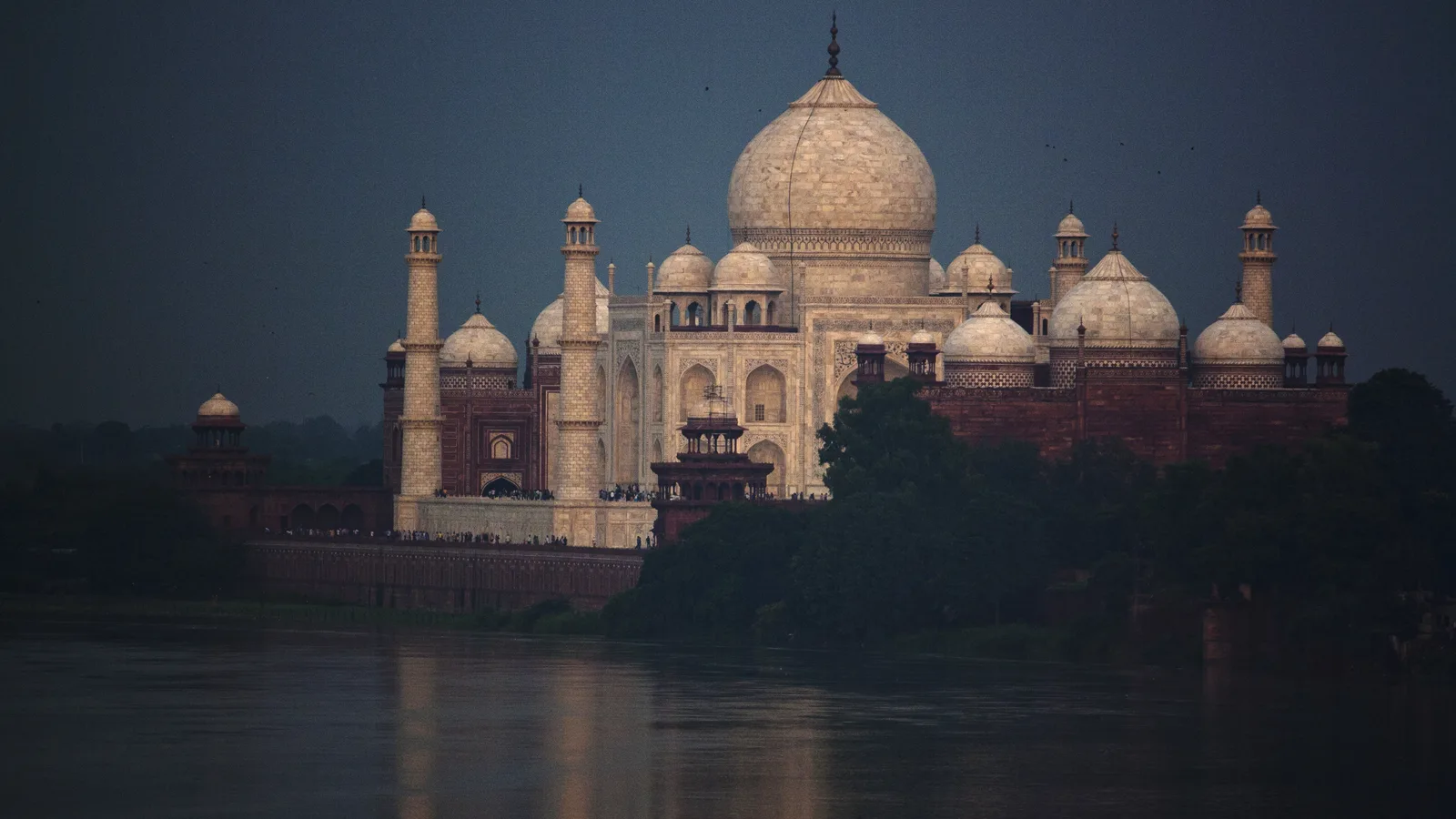
How the Taj opens at night
Night viewing is newer than many people think. According to the Archaeological Survey of India's Agra Circle, it has been allowed since 28 November 2004, on the order of the Supreme Court. Dainik Jagran has reported that before 1984 Sharad Purnima nights at the Taj had a fair-like crowd, and that night visits then stayed closed for 20 years for security reasons. When they came back, they came with firm rules.
The official Taj Mahal night view page sets out the basics:
- Night viewing is open on the full-moon night and on the two nights before and after it.
- It is closed every Friday and during the month of Ramzan.
- There are 8 batches of at most 50 people each, and each batch gets 30 minutes.
- You must report at Shilpgram, near the Eastern Gate, 30 minutes before the time on your ticket for security checks, and every visitor needs ID.
The two official sources differ slightly on timings. The Taj Mahal website gives 8 pm to 11:59 pm. The ASI Agra Circle visitor page lists eight half-hour slots from 8:30 pm to 12:30 am. Go by the time printed on your ticket, and plan on the last batches finishing around midnight either way.
Which nights in October 2026?
Several travel listings give 24, 25, 26, 27 and 28 October, built around the astronomical full moon on Monday 26 October. There is one wrinkle. Drik Panchang lists Sharad Purnima for New Delhi on Sunday 25 October, and in 2022 Dainik Jagran reported that the October night viewing was fixed around Sharad Purnima. If ASI follows the festival date this year, the window could shift by a day. Saturday 24 to Tuesday 27 October fall inside the window under either reading, so those are the safest nights to plan around. Check the dates on the booking portal before you reserve a car or a hotel.
Expect demand to peak around Sharad Purnima. Dainik Jagran wrote that visitors wait all year to see the stones set into the marble sparkle in the moonlight on that night, and with only 400 places a night, not everyone gets in.
Booking a night slot
The Taj Mahal website's FAQ says night viewing tickets can be booked online through the ASI payment portal up to seven days before the viewing date. The ASI Agra Circle page also describes a booking counter at its office at 22 The Mall, Agra, open from 10 am to 6 pm, selling tickets one day before the viewing date. It lists these points as well:
- Indian visitors need a photocopy of ID and address proof, and foreign visitors a photocopy of their passport.
- Tickets can be cancelled at the counter only on the day of viewing, up to 12 noon, with a 25% cancellation charge.
Because booking opens only about a week ahead, book the car and the hotel once you know the dates, then book the night slot as soon as it opens. For the 24 October night that means checking the portal from around 17 October. Weekend nights and Sharad Purnima are likely to go first.
Pick your night by the moon
All five nights are bright, but the moon is not in the same place at 8 pm each night. We worked out moonrise and the moon's height for Agra:
- Saturday 24 October: moonrise about 4:19 pm, before sunset. The moon is already well up, about 47° above the horizon, at 8 pm. Good for early batches.
- Sunday 25 October: moonrise about 4:54 pm. About 39° up at 8 pm and climbing. Any batch works.
- Monday 26 October (full moon): moonrise about 5:33 pm, just before sunset at about 5:39 pm. About 30° up at 8 pm.
- Tuesday 27 October: moonrise about 6:18 pm, after sunset. Only about 20° up at 8 pm, so a batch from 9:30 pm onwards will see it higher.
- Wednesday 28 October: moonrise about 7:11 pm. Just 8° up at 8 pm, still low and likely to be behind trees and buildings, so choose one of the last batches.
These are our own calculations for a flat horizon. Clouds or haze will matter more than any of these numbers, and they are worth checking on the day.
What you can and can't take in
Night viewing has stricter rules than a day visit. The official Do's and Don'ts page says mobile phones are banned for night viewing, along with the usual prohibited items: food, tobacco, chargers, headphones, knives, tripods and other electrical goods apart from a camera. A still camera is allowed after the security check, but video cameras and extra batteries are not. The ASI Agra Circle page adds that luggage is kept at a counter free of charge, and its list of prohibited items includes torches, helmets and big bags.
Plan for that before you leave the car:
- Keep your ticket and the ID you booked with together and easy to reach.
- Leave food, chargers and bags in the car or the hotel room.
- If you want photographs, bring a camera. Your phone stays outside.
The drive: Noida to Agra on the Yamuna Expressway
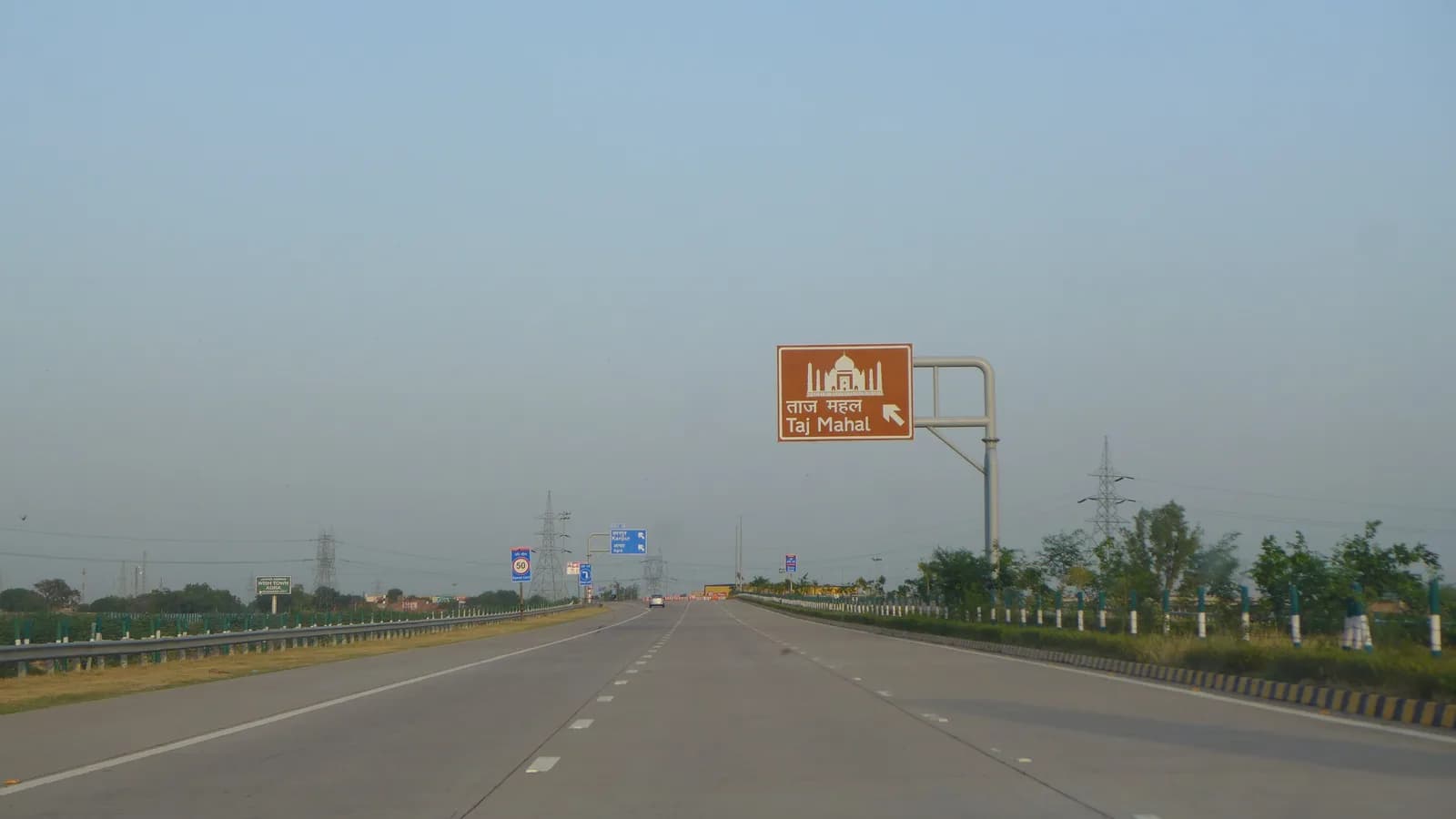
The Yamuna Expressway runs about 165 km from Pari Chowk in Greater Noida to Kuberpur on the edge of Agra. By our route check using OpenStreetMap routing:
- Sector 18 to Pari Chowk: about 27 km
- Pari Chowk to the Agra end of the expressway: about 170 km by road
- Sector 18 to the Taj's eastern side: about 204 km, roughly 2 hours 35 minutes without stops
- From the Taj to Agra Fort: about 4 km
- From the Taj to Mehtab Bagh, across the river: about 9 km by road
Hire N Ride's Noida page gives the same picture: about 200 km and 2.5 to 3 hours. Allow longer for traffic in Noida and a break on the way.
A few things to know:
- Speed: the limit for cars is 100 km/h, and the right-hand lane is for overtaking only. Lower limits are put in place in winter fog.
- Tolls: there are three main toll plazas, near Jewar, Mathura and Agra. Hire N Ride cars come with FASTag, but the Noida page advises checking this at pickup.
- Fuel: fuel stations on the expressway can be far apart, so fill up in Noida before you get on.
- Parking: the Taj's official guidance says no polluting vehicles are allowed within 500 m of the monument. For the Eastern Gate, park at Shilpgram and take the battery buses or golf carts from the parking to the gate.
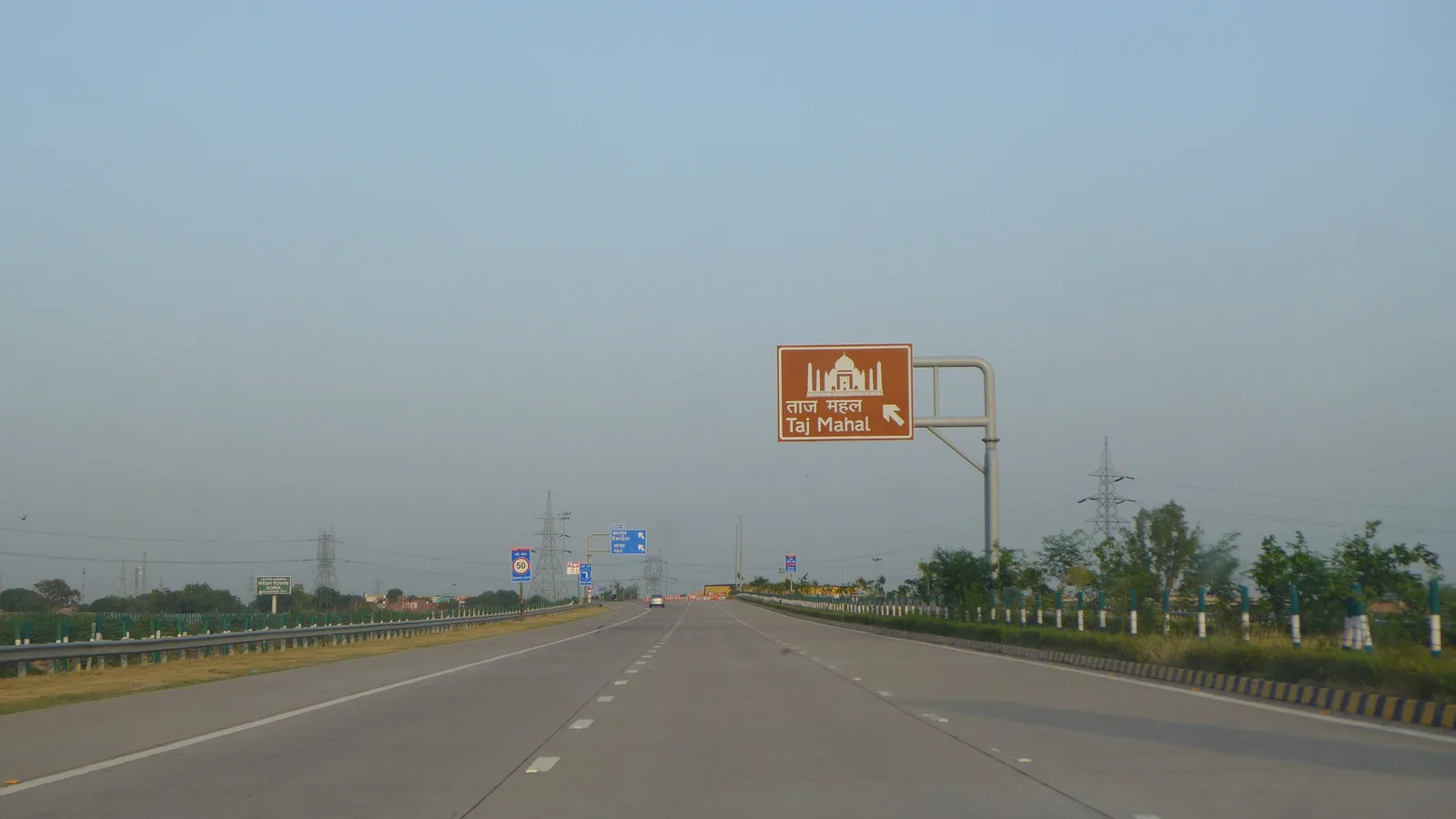
Why staying over is the better plan
On paper, you could drive down in the afternoon, see the Taj at 9 pm and be home by midnight. In practice, the timings work against you. You need to be at Shilpgram 30 minutes before your slot, and the later batches, which suit the moon on 27 and 28 October, finish around midnight. Driving 200 km back after that means a tired drive on a fast road in the middle of the night.
Staying over turns it into an easy two-day trip. We made the same argument for Pushkar from Jaipur, where same-day returns feel rushed, and it applies here even more. Hire N Ride's Noida rentals start at 24 hours, so if you pick up around lunchtime and return around lunchtime the next day, the overnight stay doesn't add another rental day.
A simple two-day plan
Day one
- Around 12:30 pm: collect the car in Noida, check the FASTag and fill up.
- Afternoon: drive down the Yamuna Expressway and check in to your Agra hotel.
- Before sunset (about 5:40 pm in late October): go to Mehtab Bagh, the garden across the Yamuna that faces the Taj. The view in the banner photo is from that side of the river. The Taj's FAQ says Agra's other monuments are open from sunrise to sunset. In 2022 Dainik Jagran mentioned the Taj View Point at Mehtab Bagh as another place to see the Taj on a moonlit night.
- Dinner, then Shilpgram: park, and be at security 30 minutes before your slot with just your ticket, ID and camera.
Day two
- Early morning, if you like: the Taj opens 30 minutes before sunrise, with sunrise at about 6:23 am in late October. A daytime visit needs a separate day ticket.
- Late morning: see Agra Fort, 4 km from the Taj, or head straight back.
- Early afternoon: drive back to Noida in daylight.
If you plan more evening trips like this, our Dev Deepawali guide for Varanasi uses the same idea of parking early and arriving on foot.
What you need for a self-drive car rental in Noida
According to Hire N Ride's Noida page, you need a valid four-wheeler driving licence held for at least a year, and you must be 21 or older. International visitors need their licence, passport and an International Driving Permit valid in India. Fuel is not included. You get the car with a set fuel level and return it at the same level. The page says Agra and Mathura trips are allowed, but check the outstation terms when you book. Security deposit refunds are started within 24 hours of the trip ending.
For Noida hosts: the Agra weekend is your busiest route
Hire N Ride works like Airbnb for vehicles. Each host builds a professional profile, and every completed trip adds to their reviews. More reviews bring more bookings, and a full-moon weekend sends a lot of renters down the same 200 km of expressway at the same time. A car that is clean, fuelled as promised and ready on time earns its host the reviews that win the next booking.
Expressway trips are hard on a car, so the basics matter. Hire N Ride manages the business side for hosts, including compliance and reminders:
- Vehicle surveys, so the car's condition is recorded before and after each trip
- GPS management, useful when your car is 200 km away on a night out
- Insurance renewal reminders
- PUC certificate tracking
- RC paperwork kept in order
- Permit expiry reminders
- Servicing schedules for tyres, brakes, wipers and lights before high-speed runs
Check the FASTag balance before each handover, since a declined tag at Jewar is a bad start to anyone's trip. If you own a car in Noida or Greater Noida, start on the List Your Vehicle page.
Conclusion: book the night first, then the bed
Seeing the Taj Mahal by moonlight takes more planning than a day visit. There are only five nights, 400 places, a 30-minute slot and a strict list of things you can't bring. From Noida, the planning is the hard part. The drive itself is one long, straight expressway. Book a slot as soon as the portal opens, pick your night by the moon, and leave your phone and bags behind. Then stay over in Agra so the night ends at your hotel, not on the road. With a self-drive car rental in Noida from a reviewed Hire N Ride host, the Taj by moonlight can be an easy weekend away.
Next steps, whichever side you're on:
- Book a ride: choose a car from a reviewed local host on the Noida car rental page.
- Become a host: list your car on the List Your Vehicle page and start building your reviews.
Images: Vanished2009 and Qirille (both CC BY-SA 4.0) via Wikimedia Commons, credited in captions. Facts checked on 8 October 2026. Night viewing dates, timings, ticket rules and prices are set by the Archaeological Survey of India and can change, so confirm them on the official sites before you travel.